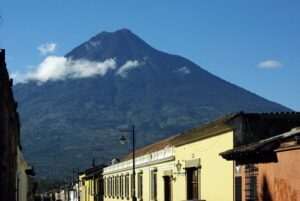
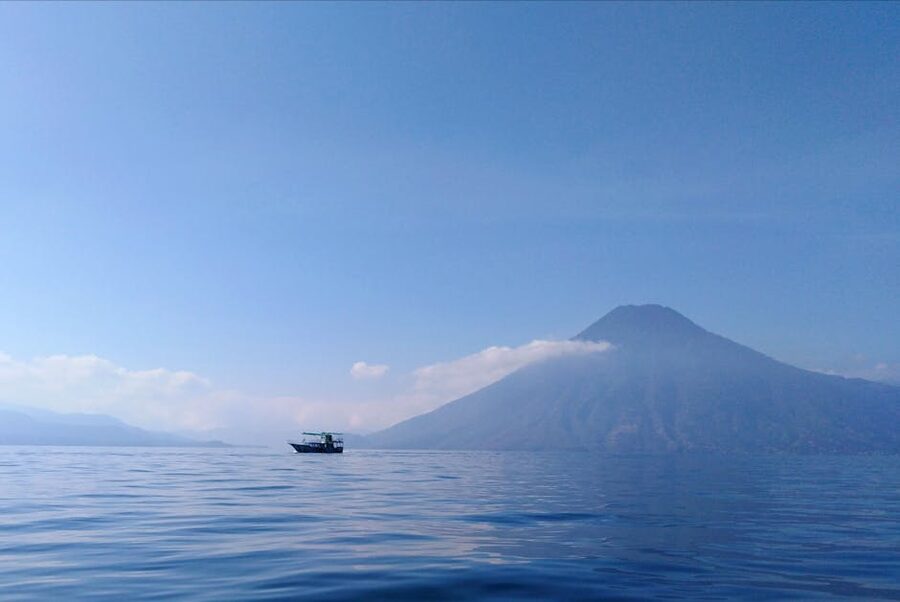
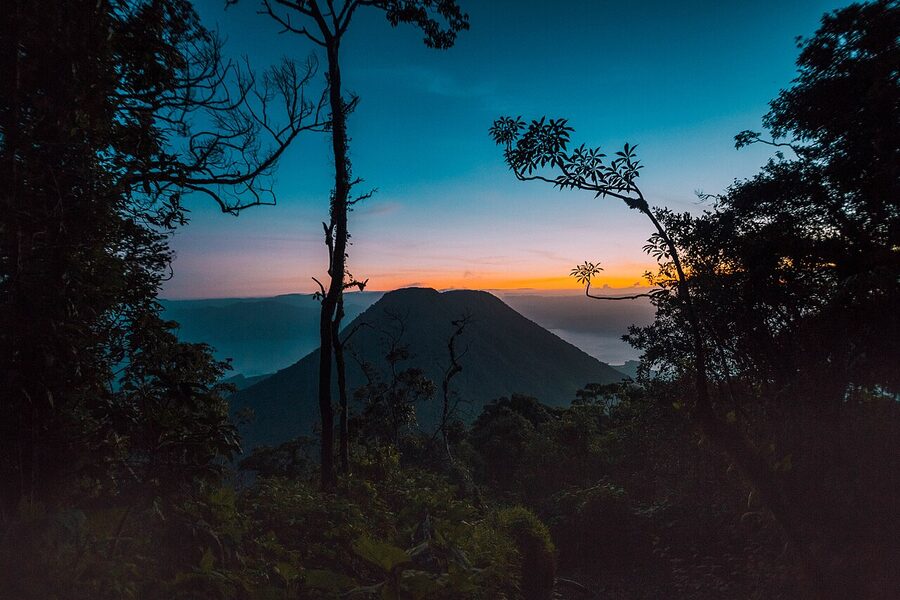
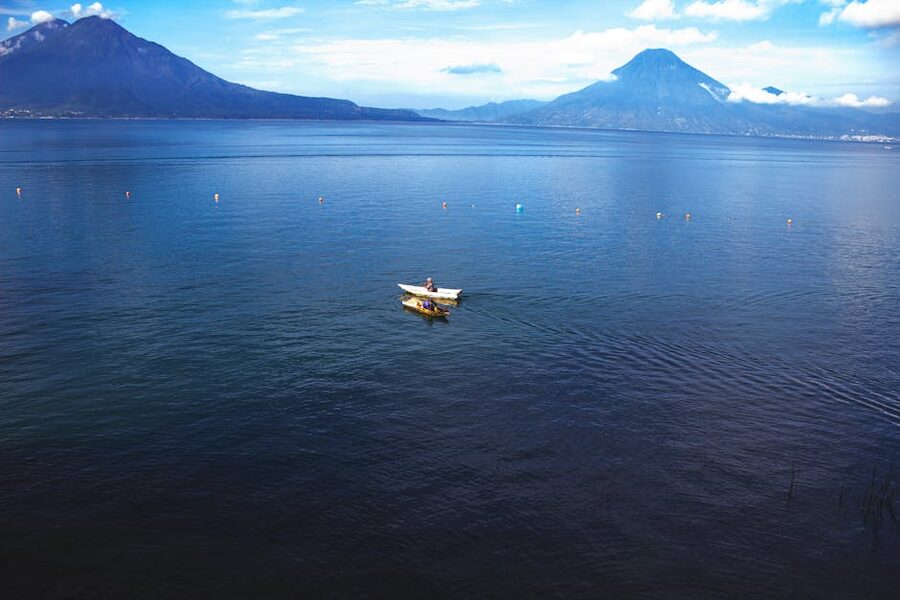
The fog hangs in the bowl of the lake just before dawn. From a Panajachel rooftop the eastern sky goes pale rose, then orange, and bit by bit the cone of Volcán Tolimán burns out of the cloud, then Atitlán behind it, then San Pedro on the far side, until you have all three guardian volcanoes back in place around 12 by 18 kilometres of dark blue water. A lone lancha cuts a wake across the surface. Somewhere down on Calle Santander a panadería is opening, smelling of warm corn.
You have probably read the Aldous Huxley line. Beyond the Mexique Bay, 1934, “the most beautiful lake in the world.” Every blogger writing about Atitlán quotes it. I will not lean on it. The more useful question is which of the eleven villages around the shore you actually want to base in, because this is not a place you “do” in a day from Antigua, and the villages are not interchangeable.
What follows is the practical version. Which village to base in, what each is good for, how the boats actually work, the hikes worth doing, where to eat, where to sleep at three price tiers, and when to go. I have favourite villages and I will tell you which.
In This Article
- The geography in 60 seconds
- The village rundown
- Panajachel (Pana): the gateway
- What to do in Pana
- Where to stay and eat
- Santa Cruz La Laguna: the dramatic dock
- Jaibalito: smaller, quieter
- San Marcos La Laguna: yoga and the rest
- San Juan La Laguna: my favourite
- Textile cooperatives
- Coffee, sleeping, eating
- San Pedro La Laguna: the backpacker town
- Spanish schools
- Volcán San Pedro hike
- Where to stay
- Santiago Atitlán: the largest indigenous town
- The Maximón shrine
- The Parroquia and the war memorial
- The lancha system
- Lancha tips
- The two hikes that matter
- Indian Nose / Rostro Maya at sunrise
- Volcán San Pedro
- When to go
- Getting there
- Money, safety, language
- How long you actually need
- The verdict
The geography in 60 seconds
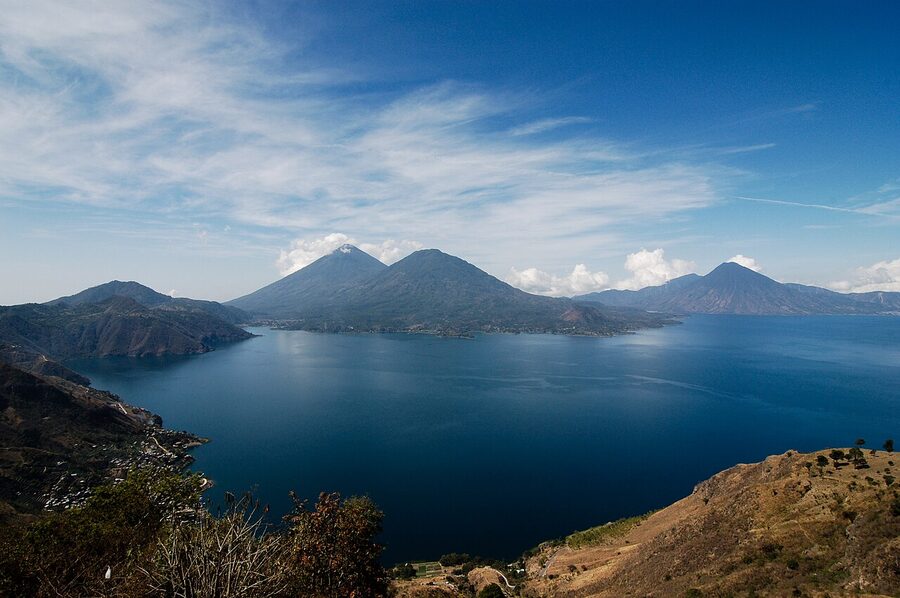
The lake sits at 1,562 metres in the southwestern highlands of Guatemala, 75 km west of Guatemala City and 2.5 to 3 hours by road from Antigua. It is what is left of a caldera that blew its top 84,000 years ago, and at 340 metres deep it is the deepest lake in Central America. Three volcanoes rise from the southern shore: Tolimán (3,158 m), Atitlán (3,535 m, the only one currently classed as active even though it has not erupted since 1853), and San Pedro (3,020 m). Eleven villages dot the rim, plus Sololá perched on the cliffs above. Each has its own Maya identity, dialect (mostly Kaqchikel and Tz’utujil, plus K’iche’ in places), typical dress, and pace. You can boat between them in 10 to 45 minutes for a few quetzales.
The village rundown
The short version, because most readers want a verdict. If you only have two or three nights, base in one place and day-trip. If you have a week, split between two villages with different vibes. The two-village split is what I would do every time.
- Panajachel: gateway, biggest, the most logistics. Best base for amenities and easy onward transport.
- San Pedro La Laguna: backpackers and Spanish students. Cheapest food and beds, the most nightlife.
- San Marcos La Laguna: yoga, cacao ceremonies, raw food, jumping platforms. Tiny.
- San Juan La Laguna: my favourite. Textile cooperatives, cleaner streets, the murals.
- Santa Cruz La Laguna: lakeside lodges, vertical village, the most dramatic dock arrival.
- Santiago Atitlán: largest indigenous town, Tz’utujil heartland, the Maximón shrine.
- Jaibalito, Tzununá, Santa Catarina Palopó, San Antonio Palopó, San Lucas Tolimán, Santa Clara La Laguna: smaller, more local, day-trip or skip depending on time.
Panajachel (Pana): the gateway
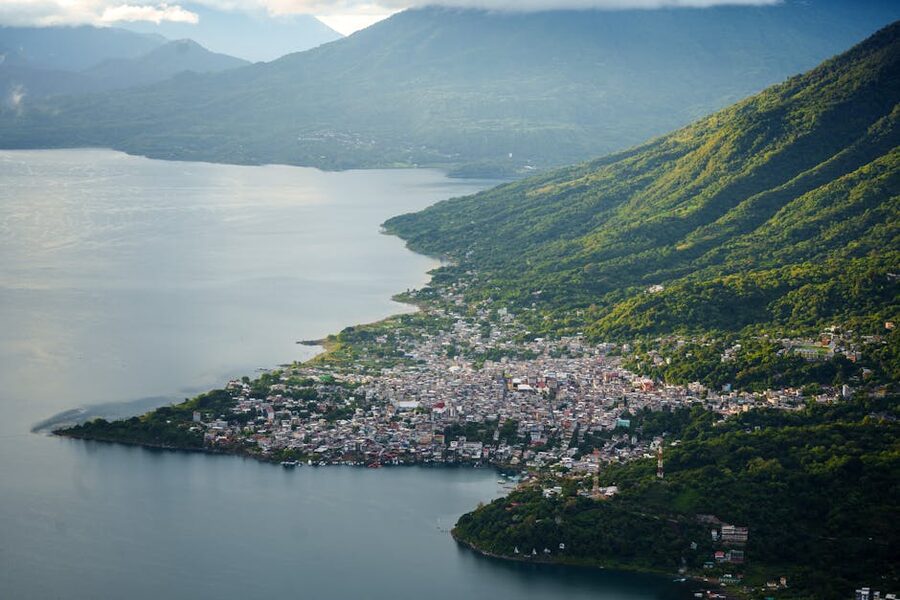
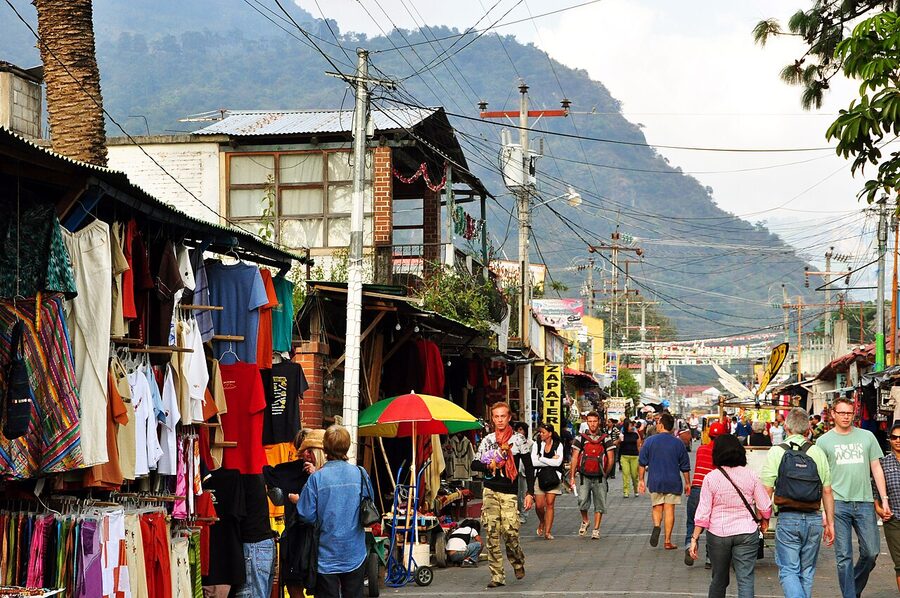
Almost everyone arrives in Pana whether they like it or not. The only road connection that matters, the biggest market, the only proper supermarkets and ATMs (multiple), and the central dock that connects to the rest of the lake. Calle Santander runs from the road down to the lakeshore: a wall of textile shops, tour agencies, jade stalls, jewellery, leather, and street food.
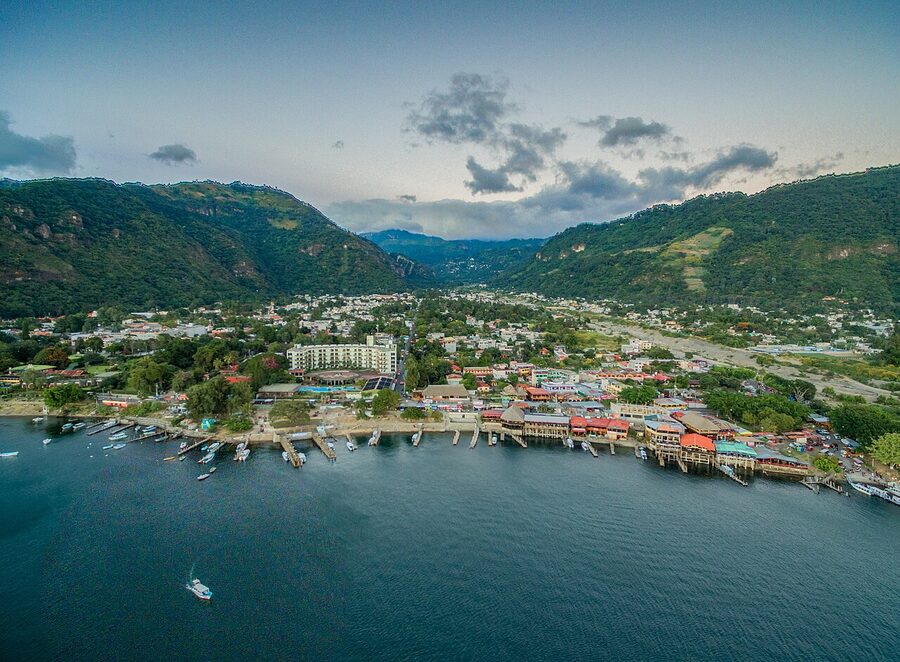
Pana gets a bad rap from travellers who roll through and continue to San Pedro the same afternoon. Fair, but it misses something. The town has been a tourist destination since the 1970s and the expat community is older and more settled than anywhere else on the lake. The Mayan stallholders and the Israeli backpackers and the Guatemalan weekenders share the same cobblestones without much fuss.
What to do in Pana
Walk Calle Santander end to end, both sides. Stop at the Museo Lacustre at the Posada de Don Rodrigo for an hour on the caldera geology and the submerged Mayan site of Samabaj, often called the “Mayan Atlantis,” whose ruins sit 18 metres down off the eastern shore. Kayak rentals on the lakefront run Q50 to Q75 per hour. The Reserva Natural Atitlán just outside town has spider monkeys, butterflies, and a couple of zip lines (entry around Q90). For sunset, walk to the public lakefront promenade and sit. The southern light catching Tolimán is the reason you came.
Where to stay and eat
Splurge: Hotel Atitlán, colonial-style lakeside, pool pointing straight at the volcanoes, 15 minutes’ walk from Santander. Mid-range: Hotel Utz Jay just off Santander, Mayan-style sauna in the garden, breakfast included. Lakefront pool option: Porta Hotel del Lago, which fills with Guatemalan families on weekends.
For food: Chez Alex on Santander is the fancy option (Q150 to Q200 for a main steak, fancy by Guatemalan standards, still cheap by yours). Crossroads Café is the place for Guatemalan single-origin coffee. Street tacos along Santander after dark are Q5 to Q10 each and the best value meal in town. Skip the “international” places near the dock with English sandwich boards.
Santa Cruz La Laguna: the dramatic dock
Santa Cruz is the first stop going west from Pana, about 10 minutes out, and it is the one where the dock arrival makes you go “oh.” The shoreline drops sheer into the lake here. Lakeside hotels cling to the cliffs above private docks reached by step-climbing trails through the gardens. The actual village of Santa Cruz is up the hill, a stiff 25-minute walk or a five-minute tuk-tuk from the lakeshore, almost entirely Maya. Two different worlds, ten minutes apart.
This is the village I would pick to spend two days reading on a hammock, swimming off a dock, watching the lake change colour. It is also home to one of the lake’s institutions: ATI Divers at La Iguana Perdida, the only outfit on the lake doing high-altitude diving. A strange and surprisingly good way to see submerged buildings claimed by the rising water levels.
Walk up to the actual village. Steep, not optional. The plaza at the top has the parish church, a couple of comedores doing Q35 platos típicos, and the sort of slow square-watching the lower lakeshore version does not offer. Stop at CECAP, the yellow social-enterprise building just below the plaza, which trains local young people in cooking, hospitality, and sewing. The upstairs café (Cafe Sabor Cruceño) does banana-and-cacao smoothies and a menu that changes with what the kitchen students are working on. Cheaper than Pana and your money goes somewhere useful.
For sleeping, the two big names are La Iguana Perdida for the social, hostel-with-character end (dorms, private cabins, family-style dinners that bring backpackers from across the lake on Saturdays), and Casa Prana for the proper splurge (yoga shala, infinity pool, suites built into the cliff). In between, Atitlán Tree House (formerly Atitlán Sunset Lodge, recently rebranded) does lakefront lofts with kitchens. All three have private docks.
Jaibalito: smaller, quieter
One stop west of Santa Cruz, Jaibalito has no road access. Boat or walk. Three or four guesthouses, a clutch of houses, a church, a population that mostly keeps to itself. The headline accommodation is La Casa del Mundo, perched on a cliff between Jaibalito and Tzununá, the most photographed hotel on the lake for good reason: rooms wedged into the volcanic rock, hot tub on a deck above the water, candlelit family-style dinner every night. Jaibalito has almost nothing to do, which is the whole point. The walk to Santa Cruz takes 50 minutes through hill villages and is one of the best hours you can spend at Atitlán.
San Marcos La Laguna: yoga and the rest
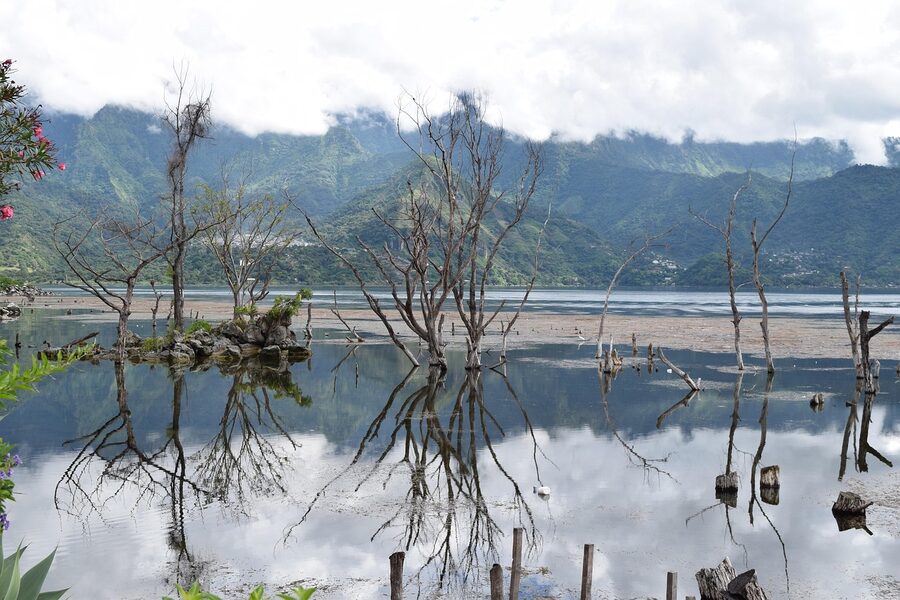
San Marcos is the lake’s wellness capital. You can identify which travellers on the boat are getting off here from a hundred metres out: loose linen, mala beads, a copy of something by Pema Chödrön. People come for week-long yoga residencies, cacao ceremonies that start with a rattle and a fire, sound baths, and a particular brand of search that the village has been catering to since the 90s.
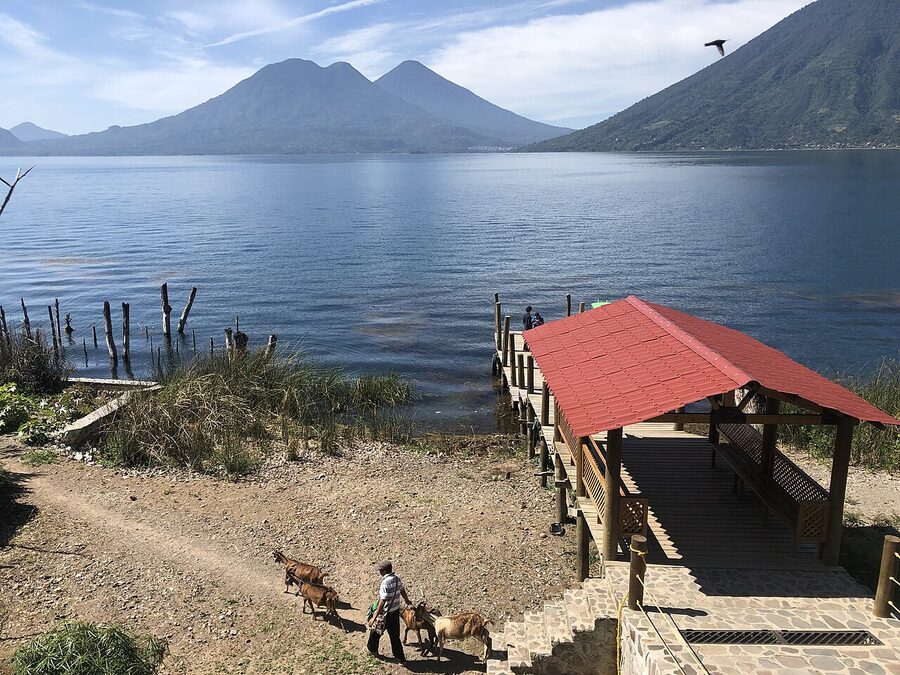
If that is your thing, you already know whether you are coming. If it is not, San Marcos is still worth a half-day for one reason: Cerro Tzankujil, a small nature reserve on a peninsula at the western edge of town with the best swimming on the lake and a wooden jumping platform 7 metres above clean water. Q15 entry, well-marked trail. The platform is genuinely high enough to require mental commitment. Take a deep breath and step off.
For wellness specifics, Las Pirámides del Ka has been doing meditation and yoga retreats since 1990 (single-day classes up to month-long lunar courses). Eagle’s Nest Atitlán uphill from the village does daily yoga and mostly-vegan meals; Lush Atitlán is the boutique option with private lake-view balconies. For food, Restaurant Fe does Indian and Asian curries that are a relief after weeks of beans and tortillas; Shambhala Café is the kombucha and slow conversation spot. Plates Q60 to Q120, cash only at most places.
San Juan La Laguna: my favourite
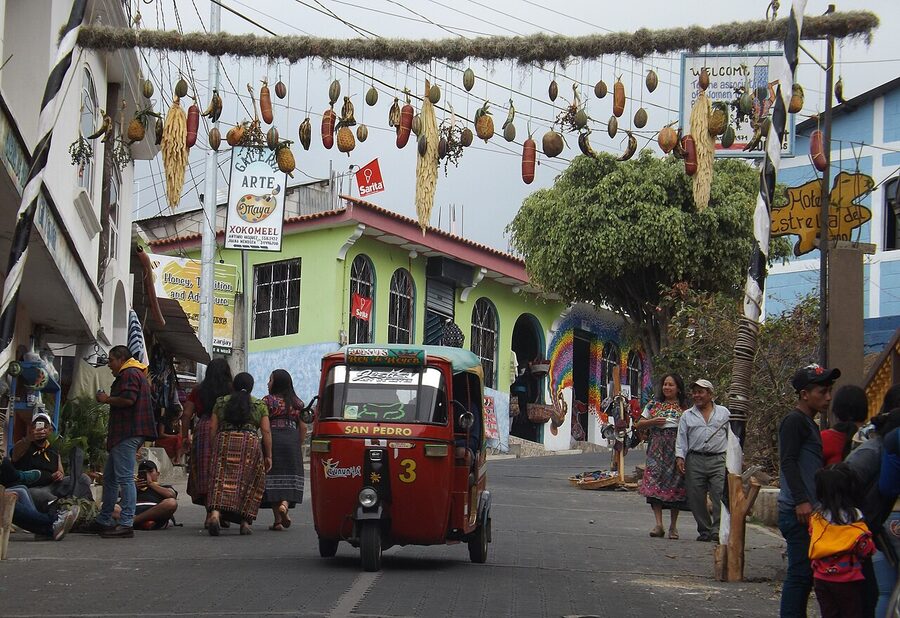
San Juan is the village I keep coming back to. One stop east of San Pedro, smaller, calmer, cleaner. The main street climbs steeply uphill from the dock, hung with strings of dried corn cobs, gourds, and coffee branches, and lined with murals painted by local artists telling the village’s history in panels. It is not for tourists. It is for the village. The fact that you can photograph it is incidental.
Textile cooperatives
The single best reason to come to San Juan is the women’s weaving cooperatives. Three or four sit on or near the main street: Lema, Asociación Lema’, Casa Flor Ixcaco, and Mujeres del Lago are the names you see most. Each works the same way. Women run the place collectively, the looms in the back are backstrap, and the dyes come from local plants and bugs (cochineal for red, indigo for blue, pericón herb for yellow). For Q15 to Q30 you get a 30-minute demonstration: how the looms work, how dyes are extracted, what the patterns mean. Then you can buy the finished pieces. Prices are higher than Pana market but the money goes directly to the woman whose name is on the label.
Coffee, sleeping, eating
San Juan has the most accessible coffee tours on the lake. The slopes of San Pedro Volcano above town are working coffee farms, mostly owned by the village cooperative. La Voz Que Clama en el Desierto (yes, that is its real name) runs farm-to-cup tours for around Q75 per person: walk up through the trees, pick the cherries, see them de-pulped and dried on the patios, end with a cup.
For sleeping, Hotel Bambú San Juan is the splurge (thatched bungalows in lakefront gardens, freshwater pool, restaurant); Eco-Hotel Mayachik’ is the eco-budget option a short walk outside town with a vegetarian restaurant. For food, the street vendors along the main calle after dark do tacos, atol (warm corn drink), and boiled-corn elotes for Q5 to Q15. Comedores run Q35 to Q50 for a plato típico.
San Pedro La Laguna: the backpacker town
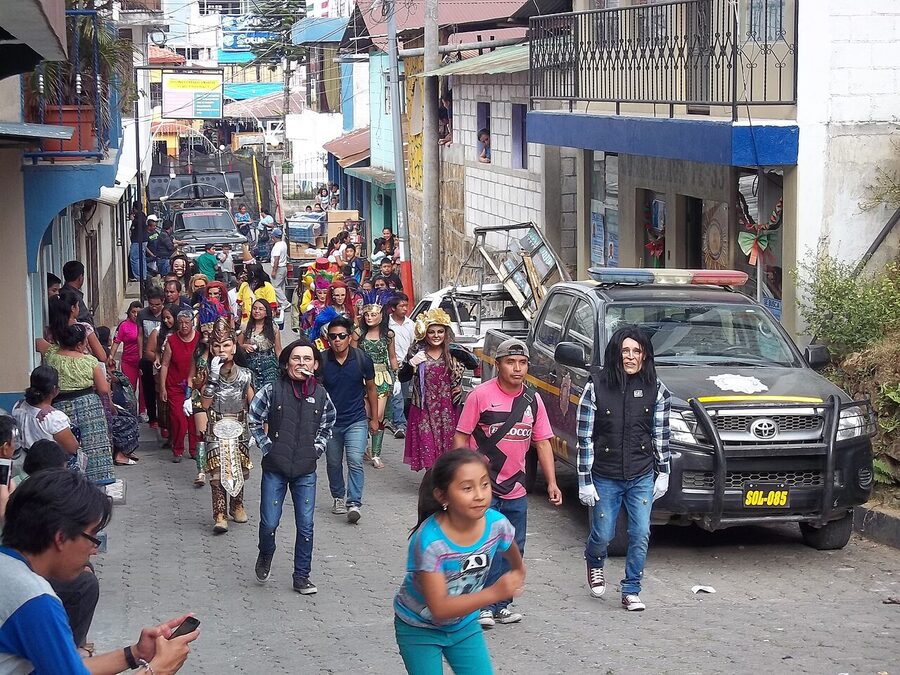
San Pedro has the loudest reputation on the lake. Cheapest, most party, the place where backpackers get “stuck” for weeks. The waterfront strip is wall-to-wall hostels, dive bars, juice bars, falafel, pizza, every flavour of cheap crowd-pleasing food. A few streets back from the dock and you are in the actual Mayan town, much quieter, with the most colourful murals on the lake.
Spanish schools
This is where San Pedro genuinely earns its place. The schools here are some of the cheapest in Latin America and the standard is good. Most run a 20-hours-per-week one-on-one model: four hours of class in the morning on a private terrace, usually with a lake view, with a single teacher. Add a homestay for full immersion. Pricing as of late 2025 is roughly Q1,400 to Q1,800 per week lessons-only, Q2,500 to Q3,200 with homestay and three meals. Three schools that come up consistently in traveller forums:
- San Pedro Spanish School on the upper strip, longest-running and most organised
- Cooperativa Spanish School, run by the teachers themselves, slightly cheaper
- Casa Rosario Spanish School, lakefront garden, popular with returning students
A week is enough to feel a real difference. A month and you will be ordering coffee, arguing with tuk-tuk drivers, and reading menus comfortably.
Volcán San Pedro hike
The most accessible of the three guardians; trailhead right above town. A tough day: 4 hours up, 3 down, 1,500m of elevation gain on a forest trail that gets rooty and steep. Robberies have been a recurring concern over the years, so go with a guide or a group, not alone. The official park entry has guides for Q200 to Q300 plus the Q100 park fee. Start at 5am to summit before midday cloud. The crater is overgrown; the “top” view comes from a viewpoint slightly below. That is normal.
Where to stay
Splurge: Sababa Resort at the quiet end of the lakefront, with pool. Mid: Hotel Mikaso has a rooftop terrace and the best pizza in town. Budget: Casa Lobo for bungalows at the calmer eastern edge, or Hotel Playa Linda for cheap private rooms close to the dock.
Santiago Atitlán: the largest indigenous town
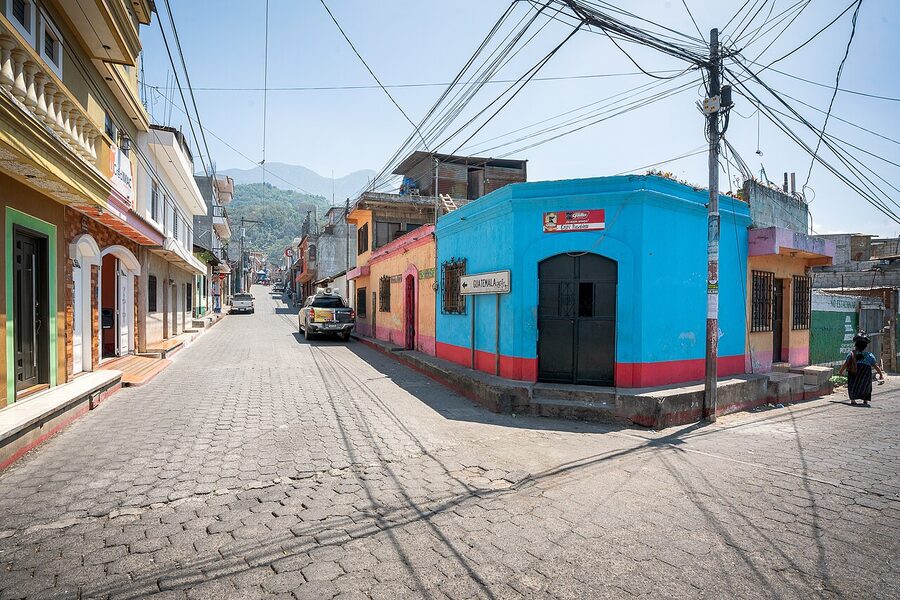
Santiago is the biggest community on the lake and the one that genuinely feels like its own place rather than an extension of the gringo trail. It sits on the southern shore between Tolimán and San Pedro volcanoes, 35 minutes by direct lancha from Pana. The Tz’utujil Maya population dominates and the town has its own typical dress: women in long purple-and-white huipiles with quetzal embroidery, men in striped white-and-purple trousers that mark them out from any other lake village.
The Maximón shrine
The single most distinctive thing on the lake. Maximón (also called Rilaj Mam, “old grandfather”) is a Maya folk deity, half saint and half trickster, dressed in scarves and a hat and a tie, smoking real cigars and drinking real Quetzalteca cane liquor that the cofradía (the brotherhood that minds him) pours into a cup for him every day. He moves house every year. The shrine rotates between cofrades’ homes and a kid will lead you there for a tip of Q5 or Q10. Inside, you make a small offering (a candle, Q20 or so), the cofrades pour Maximón a drink, you get a couple of minutes in his presence. Strange and unmissable. No photographs without explicit permission and an extra payment, and even then only of the deity, never of the cofrades.
The Parroquia and the war memorial
The main church, Parroquia Santiago Apóstol, is a 16th-century Spanish colonial pile with a syncretic interior: saints in Tz’utujil costume, Mayan symbolism in the wood carvings, and a memorial to Father Stanley Rother, an Oklahoma-born priest murdered by death squads here in 1981 for staying with his parishioners during the worst of the civil war. Rother was beatified in 2017. There is also a small memorial to the December 1990 massacre, when soldiers shot 13 unarmed civilians on the road to the army base. Santiago is the only village on the lake that puts its civil war scars in plain sight.
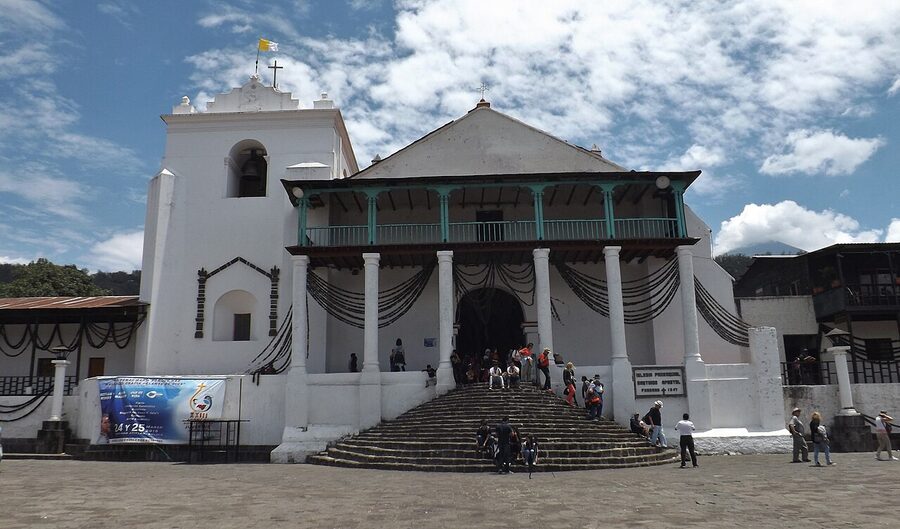
Most travellers come as a half-day trip from Pana or San Pedro. First lancha from Pana around 6am, last back around 5pm, fares Q25 to Q35 each way. If you stay overnight, Tiosh Abaj Hotel is the comfortable option close to the dock. Tuesday and Friday markets are best for traje and woven goods. Bring small bills, dress modestly, ask before photographing anyone.
The lancha system
The boats are how the lake actually works. Forget the road. It exists, but it is windy and narrow and the section between San Marcos and San Pedro is closed to most traffic because of landslides. Lanchas are the public transport.
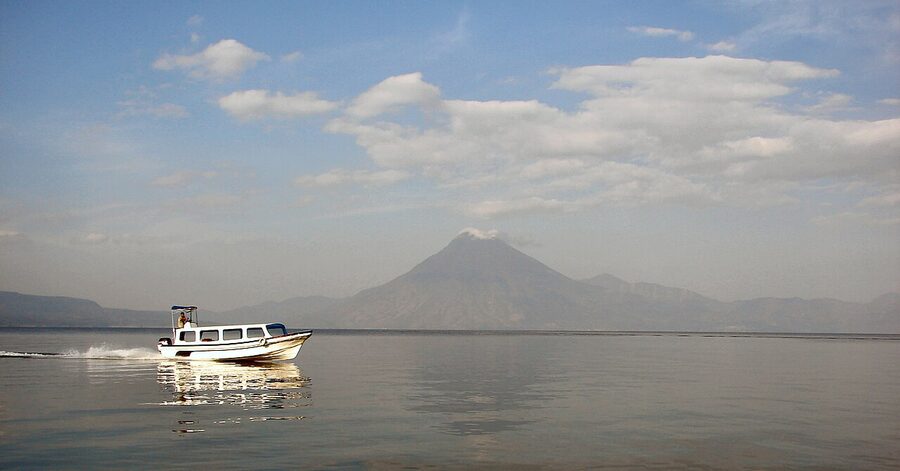
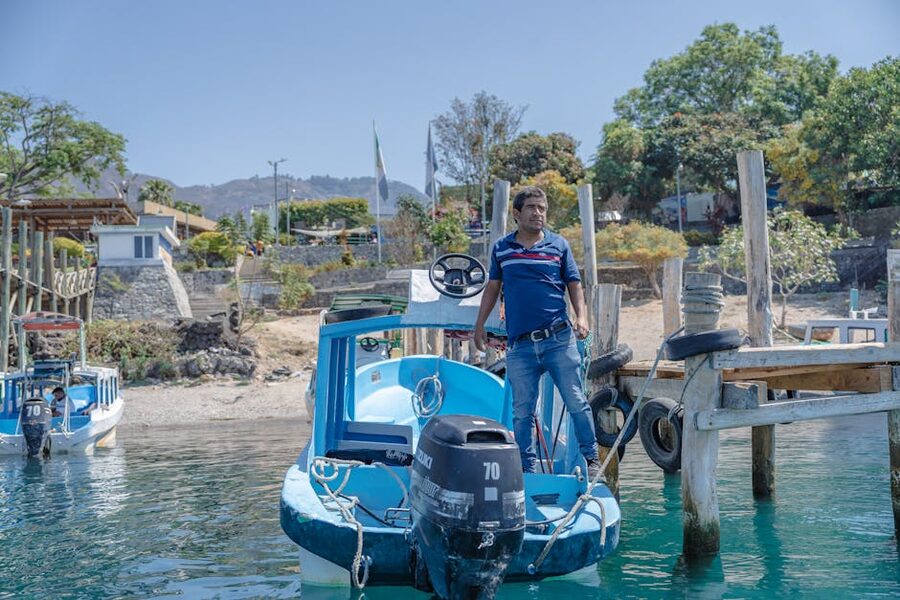
Two main lines run from Panajachel. The north shore loop stops at Santa Cruz, Jaibalito, Tzununá, San Marcos, San Pablo, San Juan, and San Pedro, roughly hourly from 6am to 5pm. About 45 to 60 minutes Pana to San Pedro stopping at every village; fares Q10 to Q25 depending on the leg. From the smaller villages you sometimes have to wave the boat down. The direct south route goes Pana to Santiago Atitlán in around 35 minutes, Q25 to Q35, every 30 to 45 minutes during the day. There is also a Pana to San Pedro direct line that skips the north shore stops in 25 minutes for slightly more.
Lancha tips
- Pay on board, at the end, in cash, in quetzales. The boatman knows who has paid. A friendly “buenos días” before discussing the price helps.
- Boats leave when full, not on a timetable. Sometimes 20 minutes’ wait, sometimes you walk on as they push off.
- The Xocomil winds kick in most afternoons, around 1pm in dry season, earlier in rainy months. Mornings are glass; the 4pm crossing back can be wet and bouncy. Do long crossings before lunch.
- Last boat back from outlying villages is usually 5pm to 6pm. Miss it and you are paying Q200 or more for a private charter.
The two hikes that matter
Indian Nose / Rostro Maya at sunrise
This is the easy one and the one you should do. The ridge above the western shore looks, in profile, like a sleeping Mayan face: forehead, nose, lips, chin. The locals call it Rostro Maya; the gringo trail still calls it Indian Nose. Same hike.
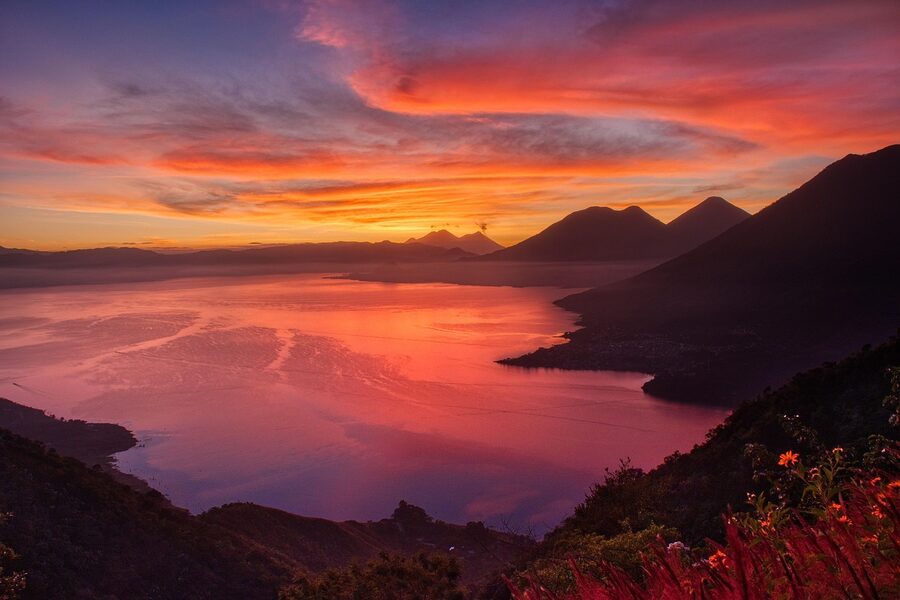
It starts in the dark from San Juan La Laguna, with a 4am hotel pickup and a 30-to-45-minute drive uphill to the trailhead. From there it is a 30-to-45-minute walk to the viewpoint, putting you on the ridge for first light around 5:45am. On a clear day the sun comes up across the lake, lighting Tolimán and then Atitlán and then San Pedro in sequence as the cloud burns off. The whole basin opens up in 360 degrees.
Cost is Q150 to Q200 with a guide, transport included. Most San Juan and San Pedro accommodations book it. There is an older route from San Pedro to the same viewpoint, but most operators have shifted to the San Juan/Santa Clara La Laguna entrance because the trail is shorter and the access road is better. The viewpoint is identical. Confirm which side your guide uses; the San Juan side is the standard now.
One caveat: it is cloudy maybe 30 to 40 percent of mornings even in dry season. If your itinerary is flexible, do the hike on the morning of your second-to-last day so you can re-book. If you only have one chance, go anyway. Even cloudy, the ridge is worth the early start.
Volcán San Pedro
The harder alternative, covered in the San Pedro section above. Worth it if you have an extra day and decent fitness; skip if you are short on time.
When to go
Two seasons. Locally verano (the dry season, summer in CA usage) and invierno (the rainy one), regardless of what the northern hemisphere calendar is doing.
Dry season: November to April. Cooler, mostly clear days, the lake at its bluest, the volcanoes visible. January to March is the peak: highland nights drop to 8 to 12°C, days top out around 24°C, air dry, most mornings the picture-perfect dawn. Prices spike and rooms fill around Christmas/New Year and Semana Santa. Book at least a month ahead for those dates.
Rainy season: May to October. Mornings usually clear and gorgeous. Afternoons regularly bring a heavy two-hour downpour from 2pm to 4pm. The lake gets choppy, prices drop, hostels empty, the slopes go intensely green. If you do not mind getting wet most afternoons, this is a fine cheaper time to come.
The Xocomil wind that funnels down the cliffs and stirs the lake is year-round but worse in rainy season. Lanchas can be cancelled or delayed. Do long crossings (to Santiago especially) in the morning.
Getting there
The standard arrival is by tourist shuttle to Pana, then onward by lancha.
From Antigua: 3 hours, Q120 to Q200. Book through your hotel or any agency on 5a Avenida; buses leave around 8am and 2pm. The road climbs to 2,300m before dropping into the lake basin, with a stop at the Sololá overlook worth getting off the bus for.
From Quetzaltenango (Xela): 2 hours, Q90 to Q150. Useful if you are coming down from the highlands.
From Guatemala City: 3 to 3.5 hours, Q150 to Q250 by shuttle. Most travellers connect through Antigua first because the shuttles are more frequent and the city is a more pleasant overnight, but direct shuttles run from the airport (GUA) for late arrivals.
By chicken bus: Antigua to Chimaltenango, then Chimaltenango to Sololá, then Sololá to Pana. Three buses, 4 to 5 hours, around Q40 total. Cheap, slow, real. Most travellers take the shuttle.
From Tikal or Flores, fly Flores to Guatemala City and shuttle in (one full day) rather than the overnight bus. The bus is 12 to 14 hours and grim. Once you are in Pana, the lancha to your final village takes another 10 to 45 minutes; add an hour to any shuttle quote you see.
Money, safety, language
Currency: Guatemala uses the quetzal (Q or GTQ). Stock up in Pana before going to smaller villages. Pana has multiple ATMs (BAC and 5B in particular), San Pedro has two or three, San Marcos has one that is often out of service, and the smaller villages have none. Cash is king for boats, tuk-tuks, market food. Bring small bills (Q5, Q10, Q20) for boatmen, who often “do not have change.”
Safety: the lake is one of the safer destinations in Central America. The Maya communities have their own codes of conduct that keep petty crime low in the villages. The two real risks are walking inter-village trails alone (especially Santa Cruz to San Marcos, ask at your hotel that morning) and the Pana market and dock area at night (pickpocketing). The US State Department’s Guatemala advisory is the standard reference; for Atitlán it recommends lanchas over walking between villages, which most travellers do anyway. Do not swim near Pana or San Pedro (water quality from runoff). San Marcos at Cerro Tzankujil and the Santa Cruz coves are clean. Avoid green-tinged water; cyanobacteria blooms occasionally close swim spots.
Spanish phrases that earn smiles: ¿Cuánto cuesta la lancha a [village]? (how much is the boat). ¿A qué hora sale la última? (what time does the last one leave). Plato típico, por favor (the set lunch). Sin picante (no spice). Buenos días until 11am, then buenas tardes, then buenas noches. A Mayan-village greeting gets you better treatment than English ever will. The country page at our Guatemala category has more on visas, CA-4 movement, and onward routes if this is part of a longer trip.
How long you actually need
Three nights is the minimum that justifies the trip. Two villages, the Indian Nose hike, two boat days. You will leave wishing you had longer.
Five to seven nights is the sweet spot. Two villages with very different vibes, both volcanoes if you want, a coffee tour, a textile cooperative day, lazy mornings on a dock.
Two weeks plus is for Spanish school people, yoga retreat people, and the occasional traveller who arrives intending to stay three nights and ends up renting a room above a panadería for a month. It happens. The lake has a slowing effect.
The verdict
Lake Atitlán lives up to its press most of the time and falls short on the days the cloud sits in too long, the wind picks up at noon, and the boats are full. It is not a packaged retreat. It is a working highland region with eleven Mayan villages around a beautiful lake, with a tourist economy layered on top of certain corners. The bits that feel manufactured (parts of San Marcos, the gringo strip in San Pedro) are still fun. The bits that do not (San Juan, Santa Cruz upstairs, Santiago, the small villages) are why you came.
If I had to pick three things: sunrise on Indian Nose from the San Juan side; a half-day in Santiago for the Maximón shrine and the Parroquia; an afternoon in San Juan with a textile demonstration and a coffee farm tour. Pana is your gateway. Santa Cruz or Jaibalito is where you hammock. San Pedro is where you study Spanish. San Juan is where I would spend my last night, watching the sun drop behind the volcanoes across the water. The lake earns its reputation on its own clear mornings, and you will know when you see one. Keep an eye on the eastern sky.