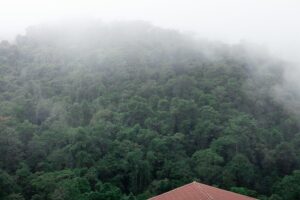
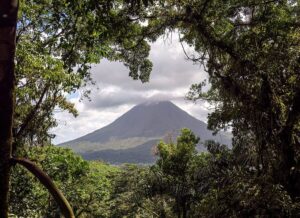
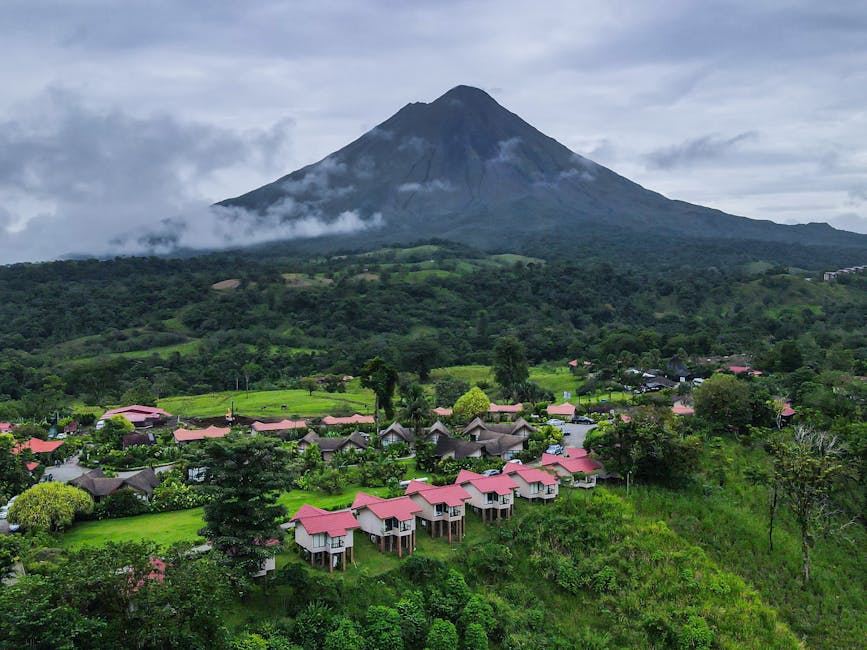
The first time I drove into La Fortuna I almost laughed out loud. You round the bend coming from San Carlos, the road dips, and there it is: a textbook cone-shaped volcano, lined up dead centre over the town like someone propped up a postcard. Arenal does not look real. It looks like a child’s drawing of what a volcano should be. Then you keep driving, and you start counting the zip-line billboards, and the hot-springs entrance arches, and the tour-shop fronts, and the volcano starts to feel less like a private discovery and more like a stage set.
La Fortuna is the most-visited region in Costa Rica, and it shows. There is a hot springs resort for every budget, a waterfall with a $20 entrance fee, a national park trail paved enough that flip-flops would survive it, and a town centre that has more or less rebuilt itself around tourists. That does not make it a tourist trap, exactly. The volcano is genuinely one of the most striking sights in Central America. The hot springs are the real deal. The wildlife is real. But walk in knowing what kind of trip you are buying. This is the most developed slice of an otherwise still-wild country.
I have been here three times: the first as a backpacker sleeping in a shared dorm above a soda for ₡8,000 a night, the second on a family trip with relatives flying in from the States who wanted volcano views and pool access, the third as part of a slower loop down to Monteverde and the Pacific. What follows is the version of La Fortuna I would brief a friend on. Where the spectacle is worth it, where to spend the colones, and how to use this place as the launching pad it actually is rather than getting stuck in the hot-spring conveyor belt.
For wider country context, the Costa Rica country guide covers regions, timing, and how a typical two-week loop fits together. La Fortuna is one of the four or five anchor stops on almost every itinerary.
In This Article
- The three names that confuse everyone: La Fortuna, Arenal, Lake Arenal
- Volcán Arenal National Park: the trails worth doing
- The hot springs question, by tier
- Splurge: Tabacón Thermal Resort & Spa
- Mid-range: EcoTermales Fortuna
- Mid-range: Baldí and Paradise / Titokú
- Free: Río Chollín / “El Choyín”
- Free: El Salto rope swing
- Catarata La Fortuna: the waterfall
- Hanging bridges: Mistico vs Selvatura
- Lake Arenal: more than a backdrop
- Day trips worth doing (and one that is a stretch)
- Río Celeste
- Caño Negro Wildlife Refuge
- The “jeep-boat-jeep” to Monteverde
- Night tours and wildlife close to town
- Where to eat in La Fortuna town
- Soda Viquez
- Don Rufino
- Lava Lounge
- Restaurante Nene’s and a couple of others
- Where to stay, by tier
- Splurge: Tabacón Thermal Resort & Spa
- Splurge: Nayara Gardens and Nayara Springs
- Splurge: The Springs Resort
- Mid-range: Arenal Springs Resort & Spa
- Mid-range: Arenal Observatory Lodge
- Mid-range: Volcano Lodge & Springs / Mountain Paradise
- Budget-mid: Hotel La Pradera del Arenal
- Budget: Hotel Secreto Fortuna and the hostel scene
- When to go
- How to get to La Fortuna
- Getting around once you are there
- Money: colones, USD, and what to expect
- Safety and practical notes
- How long to stay
- Where La Fortuna fits in a wider trip
- One last thing
The three names that confuse everyone: La Fortuna, Arenal, Lake Arenal
People use these terms interchangeably and get themselves into knots. Plainly:
- La Fortuna de San Carlos is the town. Around 15,000 people, a single grid of streets centred on a small park with a white church, restaurants and tour shops radiating out from there. Most hotels and sodas (small family-run eateries) are in or just outside town.
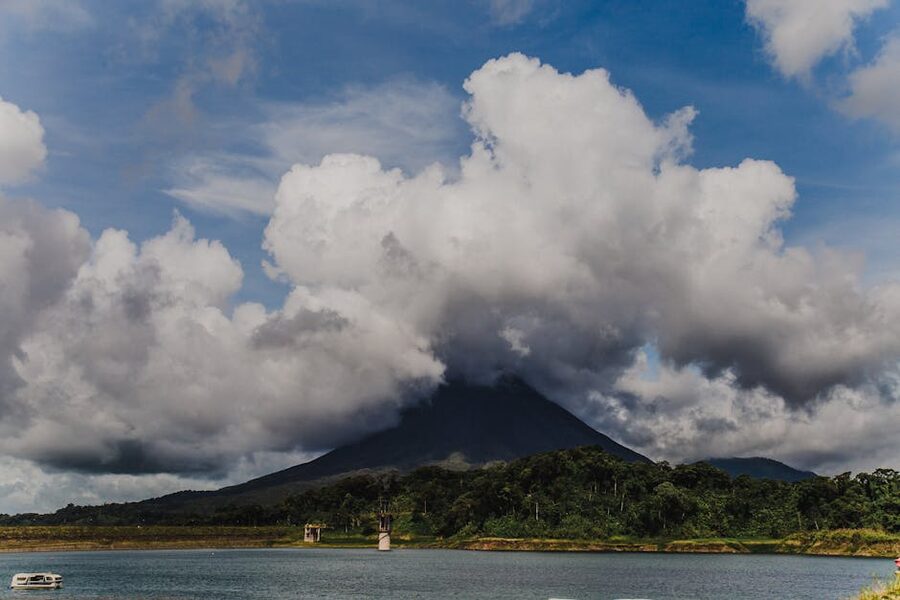
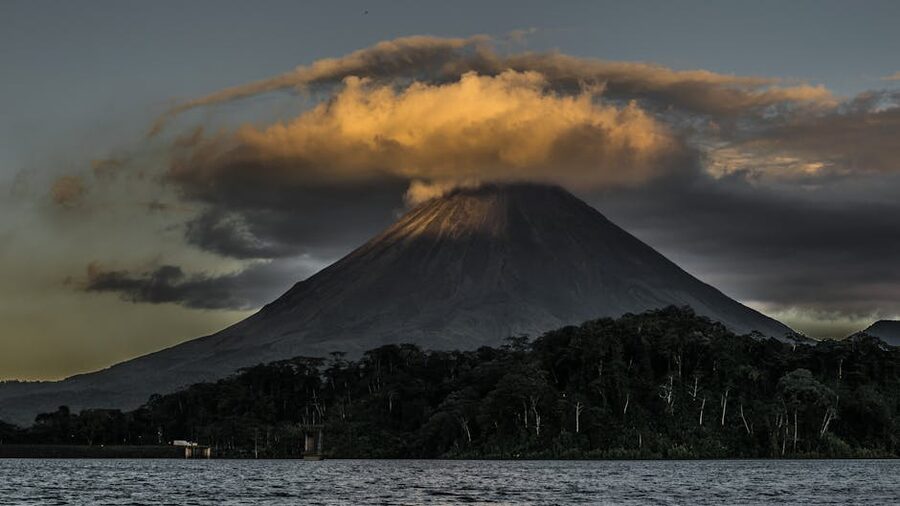
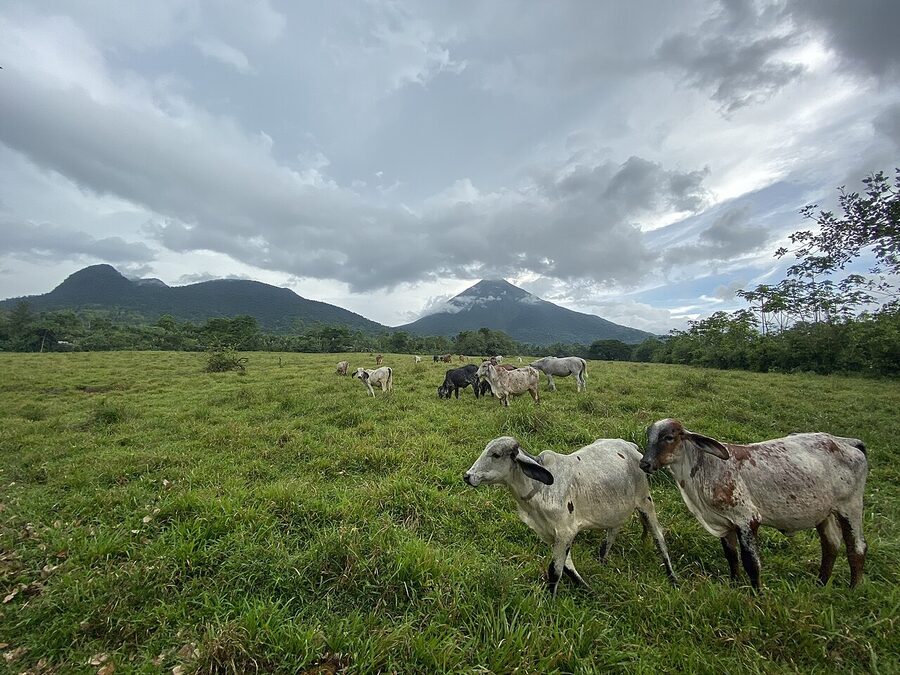
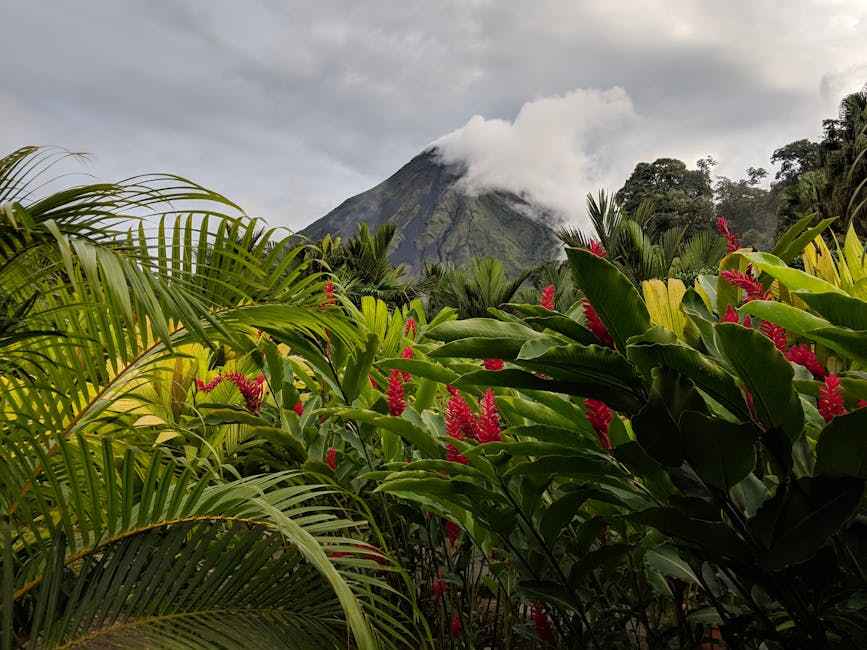
- Volcán Arenal (Arenal Volcano) is the cone. It sits about 6 km northwest of town, inside Volcán Arenal National Park. It went from one of the most active volcanoes in the world to dormant in 2010. You will not see lava. You will see the cone, the old lava fields, and on a good day the entire 1,633 metre profile from base to summit. On a bad day you will see grey cloud where the volcano should be.
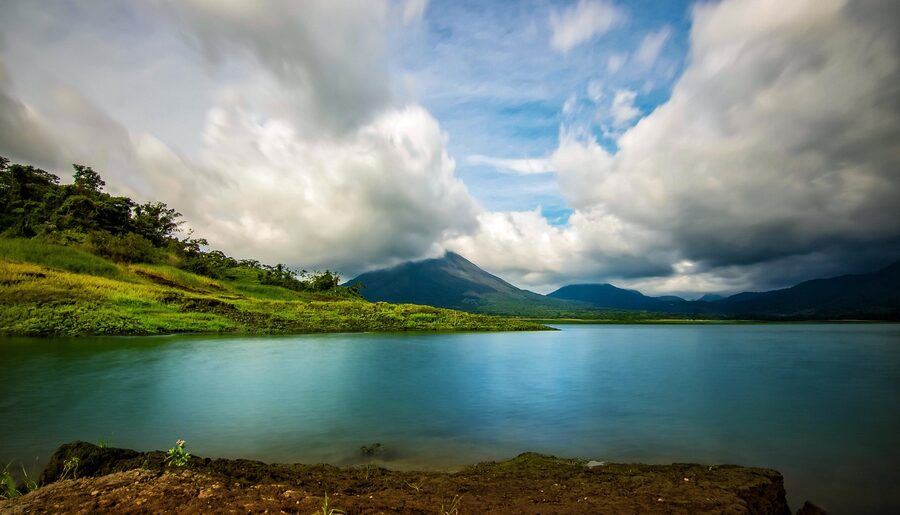
- Lago Arenal (Lake Arenal) is a hydroelectric reservoir behind the volcano, the largest lake in Costa Rica at 85 km², created in 1979 when the dam went in. Wind funnels through the corridor between the volcano and the Tilarán mountains, which is why it became a windsurfing destination.
Practical implication: when an article or a tour says “Arenal,” it usually means the broader area, not just the volcano. Most accommodation sells a “volcano view,” which can mean anything from “the cone fills your bedroom window” to “you can see a triangle of grey peeking over the trees.” Read photos carefully.
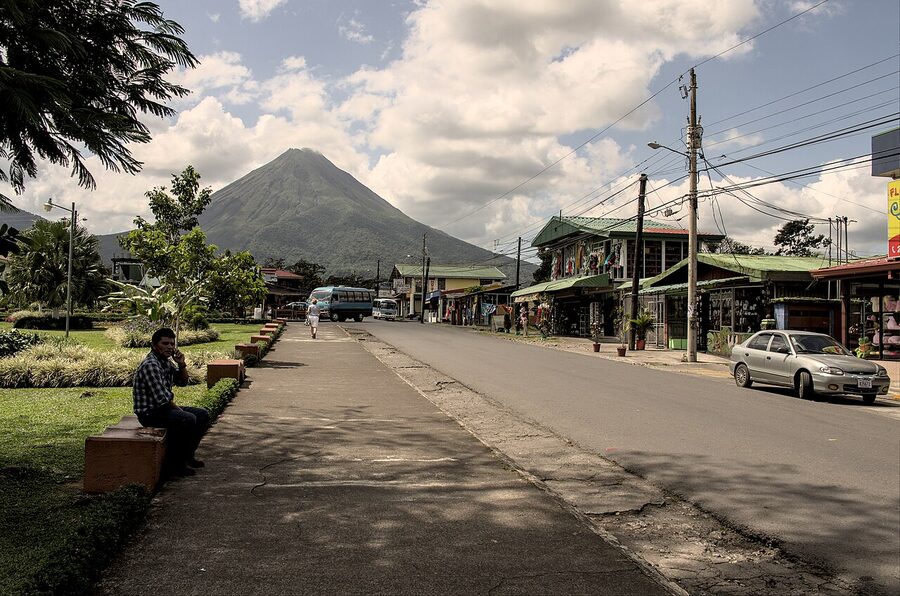
The volcano lines up with the centre of town like a stage set. The 6 km of road between the two contains most of the bigger resorts, a long ribbon of guesthouses, and the entry to the national park.
Volcán Arenal National Park: the trails worth doing
Costa Rica’s Sistema Nacional de Áreas de Conservación (SINAC) runs Arenal Volcano National Park. The park entrance is at the official ranger station off Highway 142, with the main park trail starting there. Entrance is around ₡8,500 for foreign adults at the time of writing, and yes, prices have ticked up, so check the SINAC park page before you go. Hours are roughly 8am to 4pm, last entry around 2:30pm.
The trails to know:
- Sendero Las Coladas is the headline hike. Takes you across the 1992 lava flow and up onto a viewpoint with a clear shot of the volcano, weather permitting. Roughly 3.4 km out and back, two to three hours at a normal pace, mostly flat with one short scramble. The lava field itself is interesting in the way ruined moonscapes are interesting; it is not pretty, but it is real, and you can stop and pick up the porous black rock and feel how light it is.
- Sendero El Ceibo runs through old-growth rainforest with a giant ceibo tree as the centrepiece, easy walking, about 1.5 km. Good for spotting birds and the occasional sloth. Often combined with Coladas as a loop.
- Sendero Los Tucanes is the longer forest trail, fewer crowds, no major view payoff. Skip unless you have spare time and want to walk in the woods.
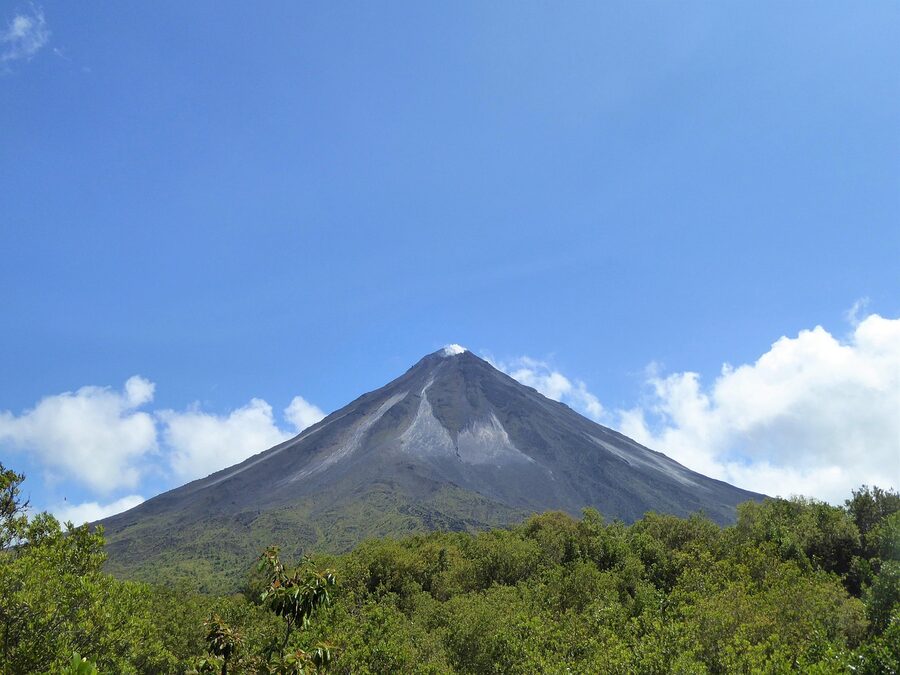
Off the official park, there is the Arenal 1968 Trail, named for the year of the catastrophic eruption that killed 87 people and rebuilt the cone. Privately operated, separate entrance, around $20 for foreigners. Different angle on the volcano, fewer crowds than the SINAC park, and arguably better views from the ridgeline. If you only have one morning, I prefer 1968 over the SINAC park trails. The scarred lava terrain feels more dramatic, and the interpretive signs are decent on the eruption history.
Practical: go early. The volcano is most likely to be cloud-free between 6am and 9am. By 11am the cap of cloud has formed and stays there until late afternoon. If you only have one morning and the volcano is in cloud when you wake up, do something else and come back. There is no point hiking trails for a view of grey.
The hot springs question, by tier
You came here for thermal water. The volcano heats groundwater that bubbles up across the area, and the entire ecosystem of resorts, day passes, and “wild” springs is built around it. There are easily a dozen places to soak. Here is how I sort them.
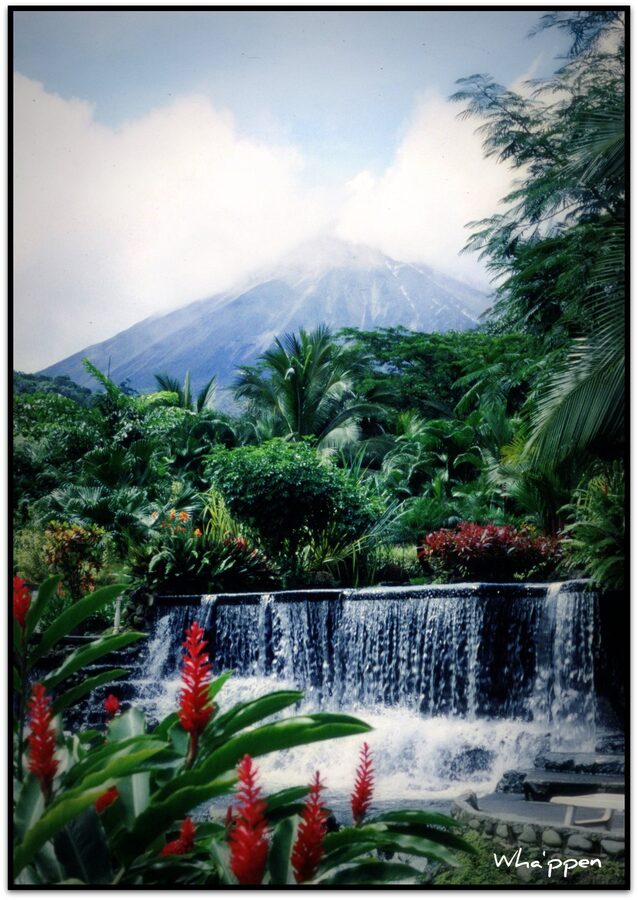
The Tabacón river, fed by geothermal flows from the volcano, runs at around 38 to 40 degrees Celsius year-round.
Splurge: Tabacón Thermal Resort & Spa
The grand dame. Multi-level pools, swim-up bar, manicured tropical landscaping that feels like a botanical garden, and an actual thermal river running through the property that you can wade up to a small waterfall. Day passes hover around $90 to $110 per person; if you stay overnight you get access to quieter guest-only sections. Tabacón on Booking.com. Worth it once, if you have the budget for a full afternoon and evening. I would not pay it twice in one trip.
Mid-range: EcoTermales Fortuna
Smaller, quieter, reservation-only, capped daily numbers. Five pools at different temperatures connected by stone paths through forest. Day pass around $40 to $55. More peaceful than Tabacón. If you care about the soak more than the swim-up bar, this is the better choice. Book a few days ahead in dry season; they sell out.
Mid-range: Baldí and Paradise / Titokú
Baldí is the opposite of EcoTermales: sprawling, water slides, dozens of pools, family-friendly, often packed. Day pass around $55 to $65. Paradise and Titokú are quieter second-tier options with stone-lined pools tucked into trees, $35 to $55 day passes. If you came here to read a book in warm water, skip Baldí and aim at one of these.
Free: Río Chollín / “El Choyín”
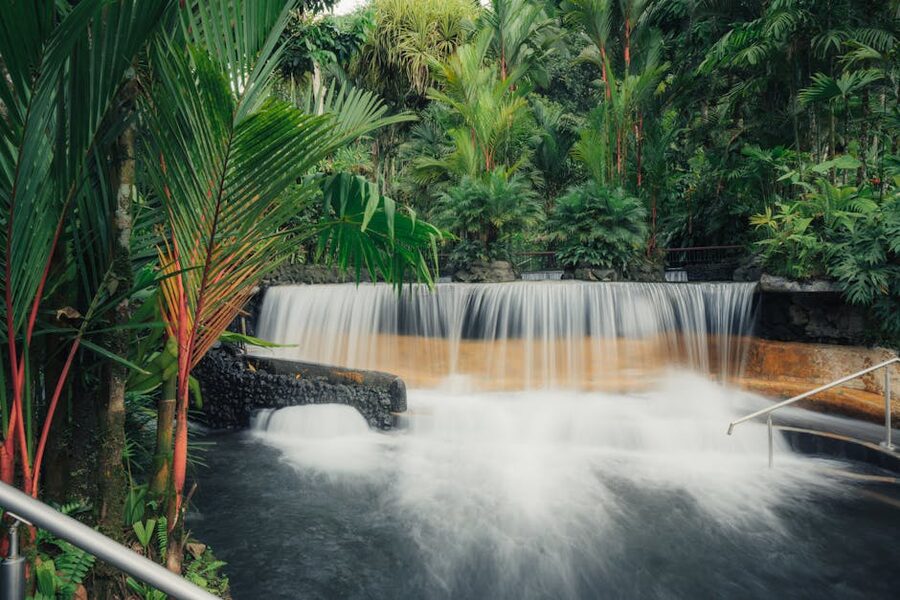
The one most travel writers undersell. Across the highway from the gates of Tabacón, on the same Río Tabacón watershed, a stretch of public riverbank gives you the same geothermally heated water for nothing. Locals call it Río Chollín or El Choyín. Park along the road shoulder, pick your way down the bank, find a warm section to sit in. No infrastructure, no changing rooms. Watch your footing on slippery rocks. Do not leave anything in your car (theft from cars at the pull-off is real and locals have flagged this for years).
I have soaked in $100 day-pass pools and at the free river in the same week, and the river was the more memorable. Actual hot springs, actual jungle, hearing nothing but water and birds. It is everything the resorts are selling minus the swim-up bar.
Free: El Salto rope swing
Different vibe, same idea. Two minutes by taxi from town, the Río Burío runs cool here rather than hot, with a thick rope swing tied to a tree above a deep pool. Locals dominate on weekends. Free, swim and jump and watch your knees on the rocks. Go on a weekday afternoon if you want it quiet.
Catarata La Fortuna: the waterfall
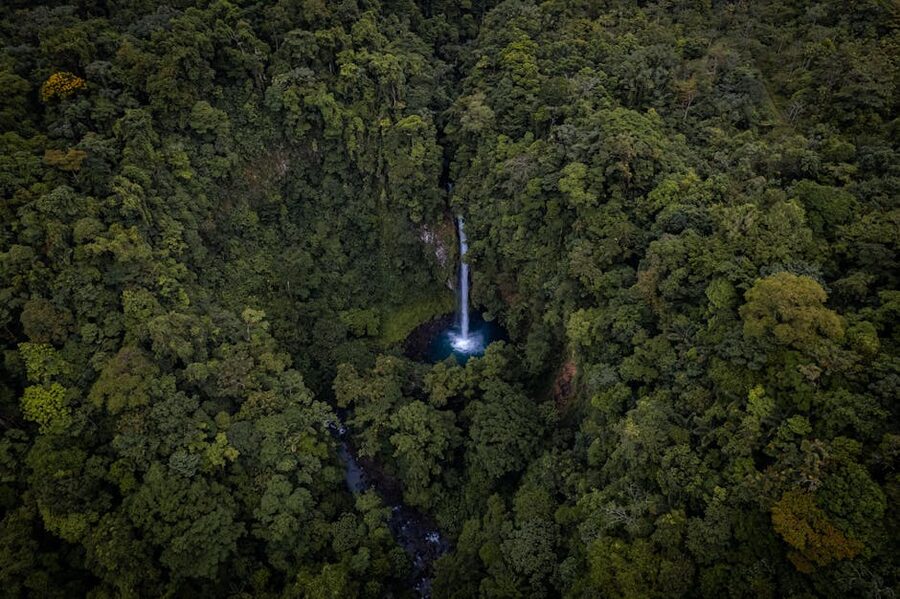
The catarata (waterfall) is the postcard. Seventy-five metres of water plunging into a turquoise pool ringed by cloud forest. Owned and managed by ADIFORT, a community development association, which is part of why entrance is steep at around $18 per adult. 530 steps down to the base, then 530 back up. Cafeteria, lockers, and a small information centre at the top.
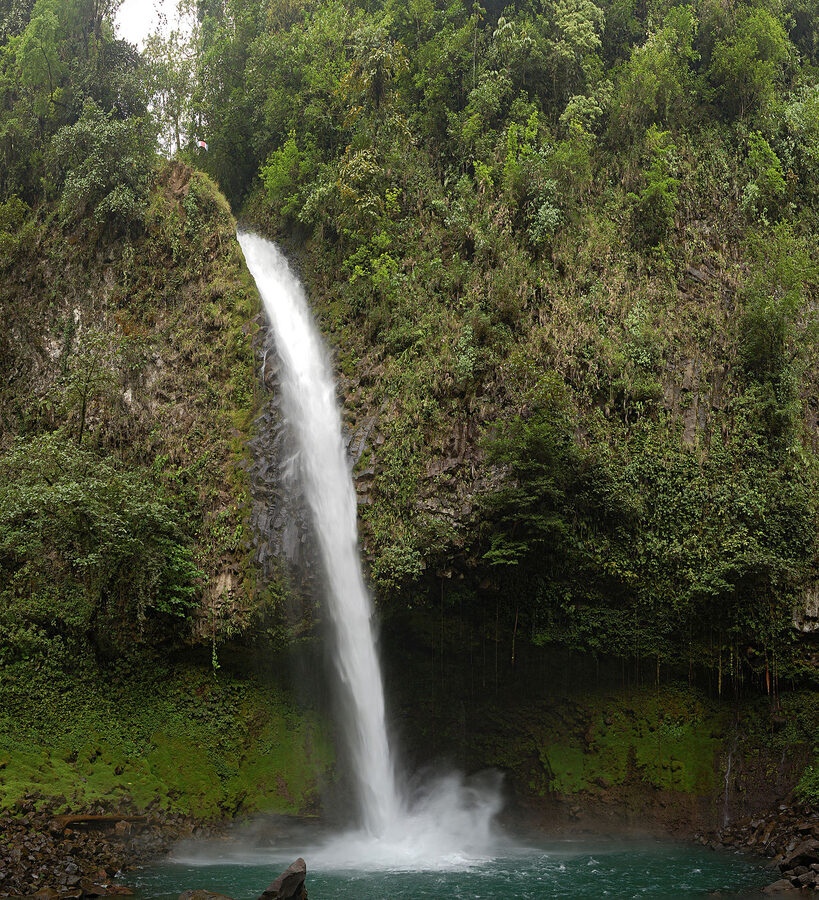
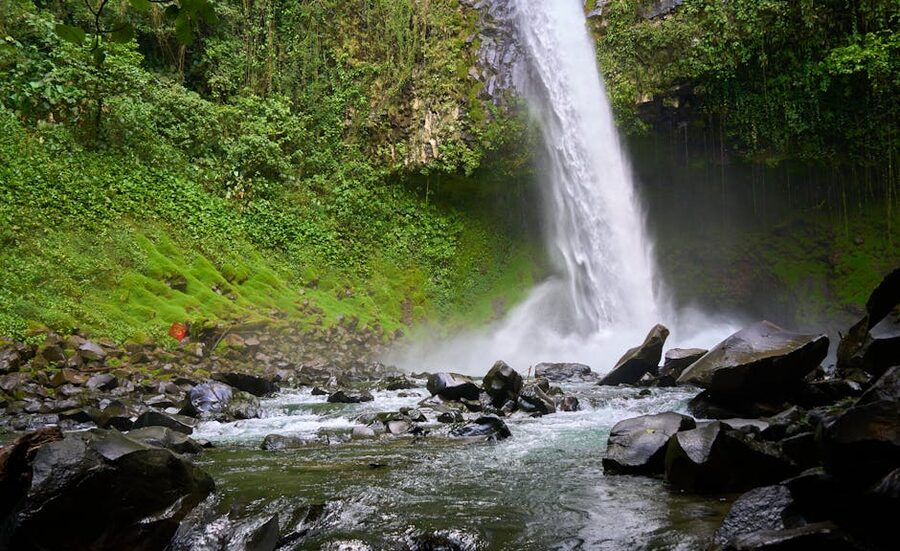
You can swim in the lower pool when the current allows; safer swimming is downstream where the water calms. Photo by Derek Ramsey / Wikimedia Commons (CC BY-SA 4.0)
Worth it if it is your first major Costa Rican waterfall. If you are already heading to Río Celeste or the Pacific waterfalls (Nauyaca, Bajos del Toro), the maths gets thinner. The catarata is beautiful but you are paying a premium for proximity. Arrive at 8am when it opens or you will be sharing the staircase with twenty tour groups. Bring water shoes; rocks are sharp and slippery. The current at the base is strong enough that swimming directly under the falls is dangerous, and there are signs marking the safe zones. Listen to them.
Hanging bridges: Mistico vs Selvatura
The hanging bridges trend. Suspension bridges strung through the rainforest canopy at varying heights, letting you walk a couple of metres above the forest floor and then thirty metres above a ravine. Best places for spotting birds, snakes, sloths, and the occasional toucan if you go early.
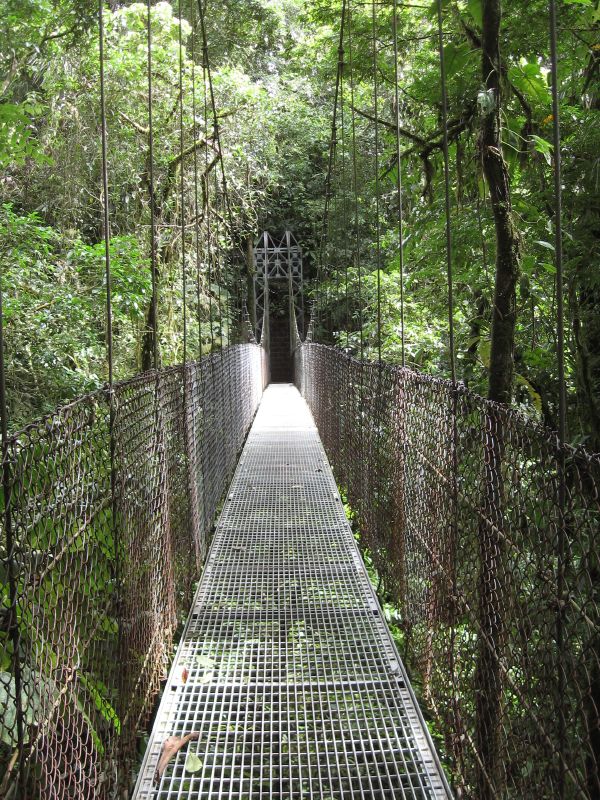
Mistico Arenal Hanging Bridges Park is the bigger and better-known one, on the western slope of the volcano, 600 acres of private reserve, 16 bridges (six suspended, ten fixed), 3.1 km loop. Self-guided around $30, guided around $50 to $60. The guided version is worth the extra if you care about wildlife; their guides have telescopes and a real knack for spotting things you would walk past.
Selvatura Park, technically in Monteverde rather than Arenal, comes up in some lists because La Fortuna shuttles run there. Skip if you are basing in La Fortuna; do it later if you head to Monteverde via the jeep-boat-jeep crossing across Lake Arenal. Selvatura is generally considered the better hanging bridges experience but it is a 3-hour drive away and not worth the day trip from Arenal.
Pick Mistico if you are basing in La Fortuna. Go in the morning. Wear good shoes; the trail is well-maintained but slick in green season.
Lake Arenal: more than a backdrop
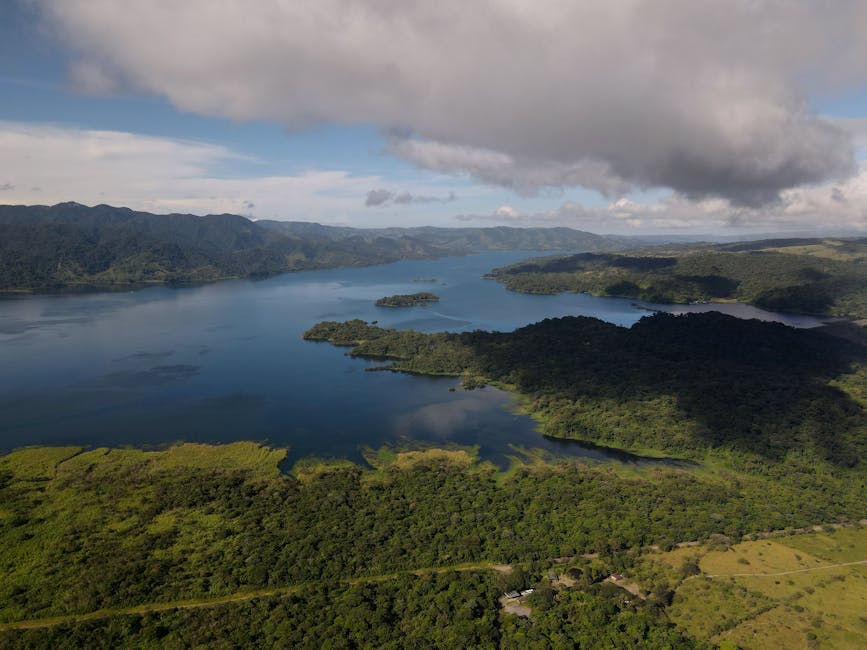
Most visitors see the lake from the dam crossing on the way to or from Monteverde and do not stop. Worth pausing.
The lake’s western end, around Tronadora and Tilarán, is where windsurfers and kitesurfers gather between December and April when the easterly winds funnel through hardest. Tilawa Windsurf Center on the south shore is the long-running operator. Lake Arenal regularly makes top-five lists for steady year-round wind.
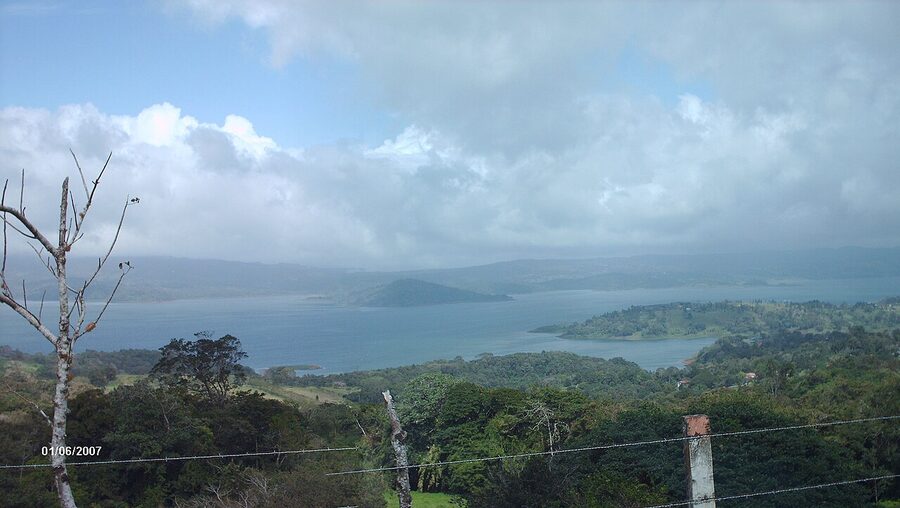
Stand-up paddleboarding has taken off on the eastern, calmer end near the dam, with the volcano in the background of every photo. Hour-long rentals run ₡10,000 to ₡15,000. For a slow day, drive the road around the southern shore. It passes German bakeries (there is a long-standing German immigrant community here), small artisan shops, and viewpoints with the volcano framed across the water. Tom’s Pan bakery in Nuevo Arenal is a known stop for pretzels and sourdough. With a rental car, a worthwhile half-day. Without one, impractical.
Day trips worth doing (and one that is a stretch)
Río Celeste
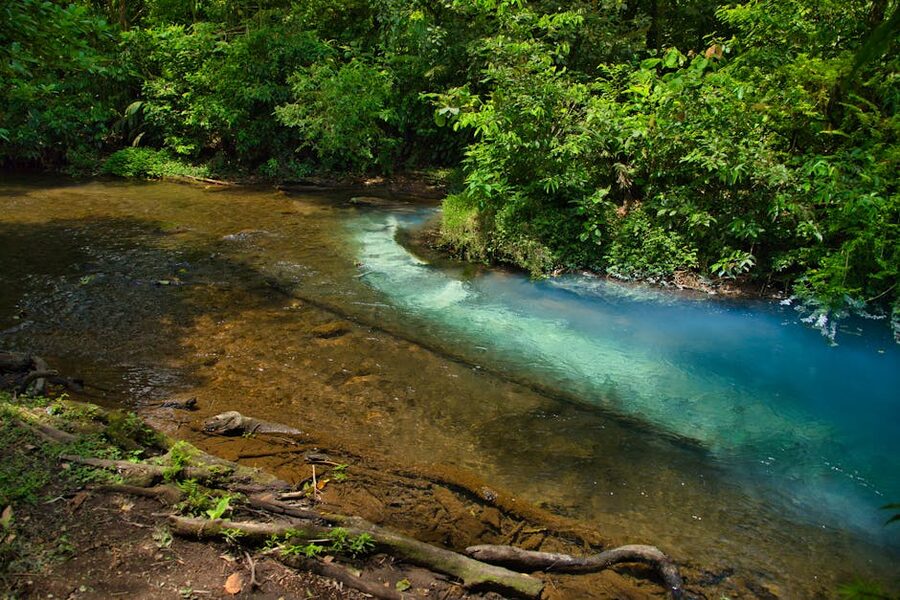
The famously blue river inside Tenorio Volcano National Park, around two hours northwest of La Fortuna. The colour is real, not edited; it is a mineral effect from where two clear rivers merge and aluminium silicate scatters blue light. The hike to the waterfall is around 6 km round trip, mostly on a wooden boardwalk through cloud forest, with the last stretch involving a steep staircase down to the catarata viewpoint.
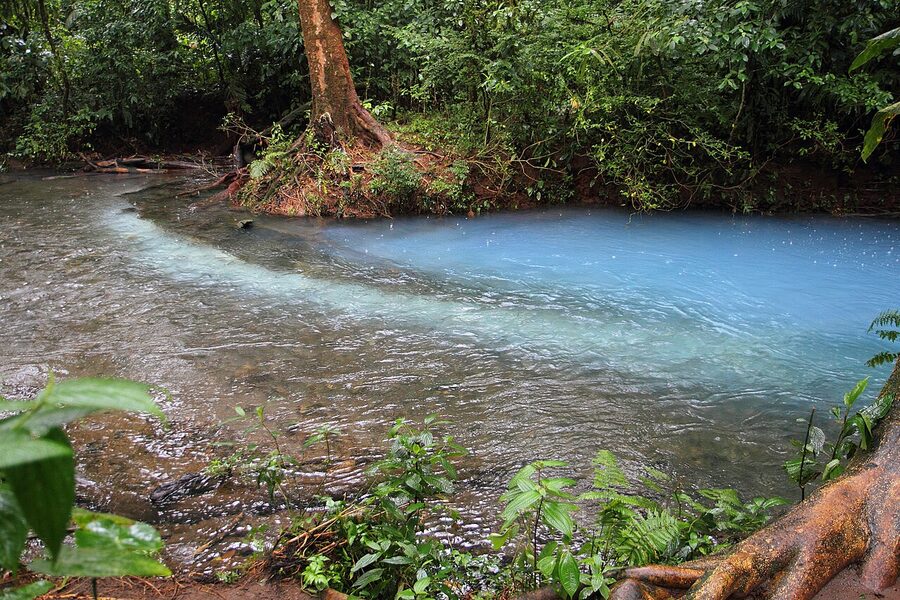
The water has to be calm and clear for the colour to pop. After heavy rain it goes brown for a day or two. Photo by Cephas / Wikimedia Commons (CC BY-SA 4.0)
Worth the day? Yes if you have a rental car and the weather has been dry. No if it has been pouring for three days, or if you are doing a tour that bundles two hours of driving each way for an hour at the river. Either rent the car and go on your own, leaving La Fortuna at 6am, or skip it and save the day for something closer.
Caño Negro Wildlife Refuge
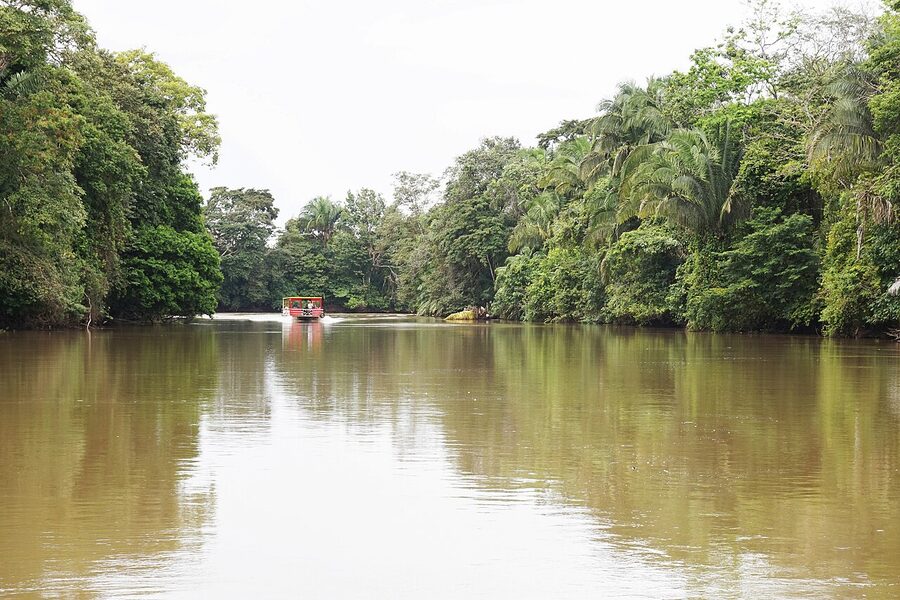
Around two hours north toward the Nicaraguan border, this freshwater wetland is one of the most important migratory bird sites in Central America. Tours run as full-day shuttles from La Fortuna and include a 2-hour boat ride down the Río Frío. Expect caimans, howler monkeys, river otters, and easily a hundred bird species in a good morning, including roseate spoonbills, anhingas, and several heron varieties. Sloth sightings are routine.
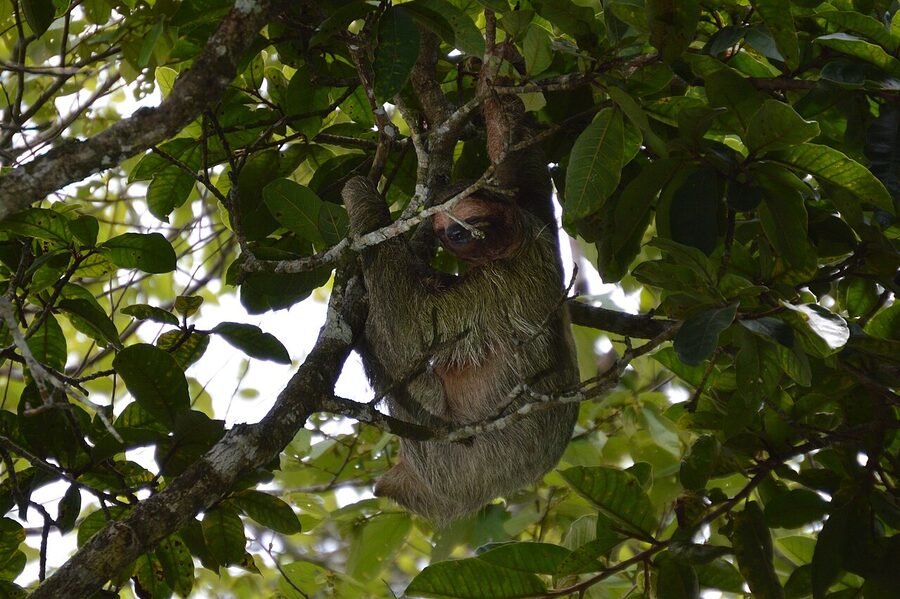
The dry-season water level shrinks the wetland and concentrates the wildlife into smaller pools, so January through April is peak. Photo by Aude / Wikimedia Commons (CC BY-SA 4.0)
If you are not continuing on to Nicaragua, this is your closest taste of the wilder Central American wetland environment. Caño Negro punches well above what most travellers expect. Tours run around $80 to $110 per person including transport, lunch, and the boat. Worth it.
The “jeep-boat-jeep” to Monteverde
If you are heading from La Fortuna to Monteverde cloud forest next, the standard route is the jeep-boat-jeep transfer: a 4WD picks you up in La Fortuna, drives you to the eastern shore of Lake Arenal, you take a 30-minute boat across the lake, then a different 4WD picks you up on the western side and drives you up to Monteverde. Total time around three hours. Costs roughly $30 to $50 per person and saves you a four-hour drive around the lake on rough roads. Almost everyone does this rather than the long way around. Not strictly a day trip but worth flagging here because it is the natural next move from La Fortuna for most itineraries.
Night tours and wildlife close to town
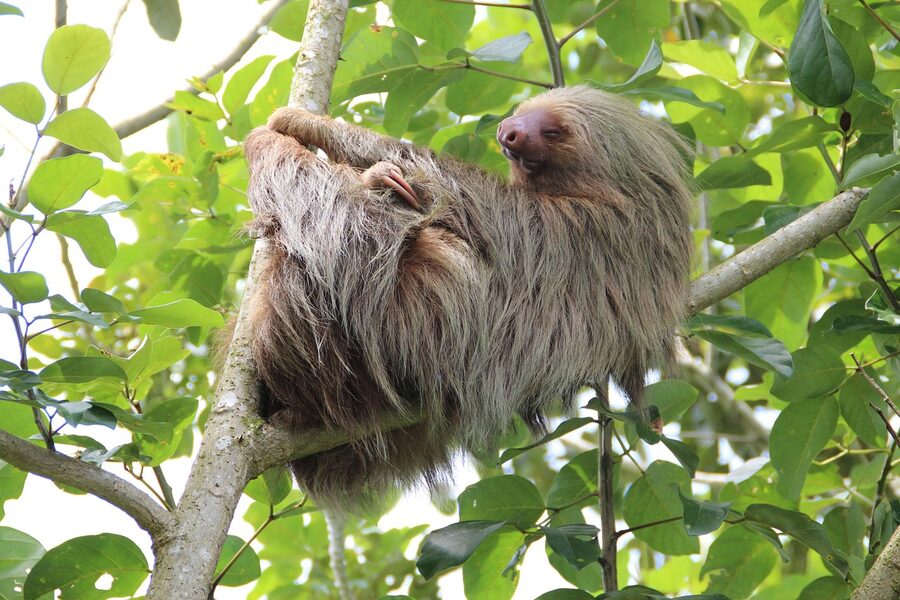
Two recommendations close enough to walk or short-taxi from town:
- Bogarín Trail is a small private reserve famous for sloth sightings. Walk-in or guided. The guided tour costs around $35 and is genuinely worth it; the guides have spotting scopes and know which trees the sloths favour. Self-guided you will see far less. Two-hour walk on flat trails.
- Ecocentro Danaus is a small reserve with ponds, butterflies, frogs, caimans, and a 1 km nature trail. Day visit is fine but the night tour is the highlight: red-eyed tree frogs, Geoffroy’s spiders, glass frogs, possums. About $40 with guide. Five minutes from town centre.
Both of these beat sitting in your hotel after dark and staring at the volcano in cloud. They also let you offload the wildlife agenda to a 90-minute window, freeing up your days for hiking and hot springs.
Where to eat in La Fortuna town
The town has rebuilt itself around tourism, so most of the main street is geared at visitors. The good news: a handful of genuinely solid spots have survived.
Soda Viquez
The local soda I send everyone to first. A block off the central park, run by a Tico family for years. Breakfast is gallo pinto (rice and beans cooked together with sofrito) for under ₡3,000; lunch is a casado (a heaped plate with rice, beans, plantains, salad, and chicken, beef, or fish) for around ₡4,500 to ₡5,500. Buffet at lunch on busier days, table service in the evenings. The kind of food you want after walking 530 steps back up from the catarata.
Don Rufino
The town’s best fine-dining option. Elevated Tico cuisine, a strong cocktail program, fresh seafood from the Pacific, mains in the ₡10,000 to ₡18,000 range. Right on the main street. Reserve in dry season. The corvina (sea bass) ceviche and the tenderloin are reliable. Service can drag when full but the quality holds.
Lava Lounge
Casual gastropub vibe, decent burgers and sandwiches, reliable wifi, full bar. Mains around ₡6,000 to ₡10,000. Good for a long lunch between morning hike and afternoon hot springs.
Restaurante Nene’s and a couple of others
Less polished than Don Rufino, more substantial than Soda Viquez. Wood-fire grilled meats, large portions, popular with Costa Rican families. The parrillada (mixed grill) for two is the move. If you are around for a few days, add Chocolate Fusión for desserts (Costa Rica’s cacao game is real) and Anch’io for thin-crust pizza when you have eaten one casado too many.
What to skip: the tourist-oriented spots with English-only menus, photos of every dish, and someone outside trying to wave you in. Everywhere on the main drag, mediocre at twice the price.
Where to stay, by tier
La Fortuna lodging spans every budget. The town has hostels and small guesthouses; the road out toward the volcano has the bigger resorts and lodges; the lake area has more isolated retreats. Prices climb fast as you move from town toward the volcano.
Splurge: Tabacón Thermal Resort & Spa
The flagship. Volcano views, signature thermal river running through the property, multiple restaurants. Rooms run $400 plus per night in dry season. If you want one luxury night and a private hot springs experience, this is the play. Check Tabacón on Booking.com.
Splurge: Nayara Gardens and Nayara Springs
Sister boutique properties, eco-luxury done with restraint, individual casitas instead of a sprawling resort feel. Nayara Gardens is the all-ages property with a strong restaurant program. Nayara Springs is adults-only with private plunge pools fed by hot springs at every villa. $700 to $1,400 a night for Springs in high season; Gardens is cheaper. Nayara Gardens on Booking.com | Nayara Springs on Booking.com.
Splurge: The Springs Resort
Larger and more amenity-packed than the Nayara properties: multiple thermal pools at varying temperatures, on-site wildlife sanctuary, several restaurants. Family-friendly, closer to a US-style mountain resort feel. The Springs Resort on Booking.com.
Mid-range: Arenal Springs Resort & Spa
The reasonable middle. Volcano-view rooms, multi-tiered hot spring pools that are guests-only (so they stay quiet), around $250 to $400 a night depending on season. If you want hot springs access without paying Tabacón rates, this is the answer. Arenal Springs on Booking.com.
Mid-range: Arenal Observatory Lodge
The pioneer property, built originally as a Smithsonian volcanology research station. Closer to the cone than anywhere else, on a ridge with arguably the best volcano view in the area. $200 to $400. Worth it if the volcano view is the reason you came. Arenal Observatory Lodge on Booking.com.
Mid-range: Volcano Lodge & Springs / Mountain Paradise
Two reliable mid-tier options on the road between town and the volcano. Volcano Lodge runs around $180 to $300 a night with hot springs on site (Volcano Lodge on Booking.com). Mountain Paradise has cabin-style rooms in tropical gardens at $150 to $260 (Mountain Paradise on Booking.com).
Budget-mid: Hotel La Pradera del Arenal
Right in town, walkable to everything, simple and clean rooms with volcano views from some, a small pool. Around $80 to $130 a night, which in La Fortuna is genuinely good value. You sleep an easy walk from Soda Viquez and Don Rufino. Hotel La Pradera on Booking.com.
Budget: Hotel Secreto Fortuna and the hostel scene
Hotel Secreto sits in town, cheap and cheerful at around $50 to $90 a night. Hotel Secreto on Booking.com. For backpackers, Selina La Fortuna is the standard hostel-plus-cowork option, around $25 a dorm bed, with a pool and bar.
When to go
Costa Rica runs on two seasons: dry (verano, December to April) and green (invierno, May to November). Both work for different reasons.
Dry season (Dec to April): the volcano is most likely to be cloud-free, trails are not muddy, wildlife sightings stay reliable. Prices peak, especially Christmas through New Year and Easter week (Semana Santa), and trails feel busy with cruise-ship day-trippers up from Puntarenas. March can already feel hot in mid-afternoon.
Green season (May to November): rain falls daily but typically as a heavy 2 to 4 hour storm in the afternoon rather than all-day grey. Mornings are often clear. Prices drop 20 to 40 percent. The forest looks greener and feels more alive. Downside: volcano views are less reliable and trails get muddy. September and October are the wettest and worth dodging.
The sweet spot: late April or early May, just as the dry season ends and the rains have not fully kicked in. Or late November and early December, just before the high-season crowds arrive.
How to get to La Fortuna
From San José’s Juan Santamaría International Airport (SJO), it is about 130 km and roughly 3 hours by road. Three options:
- Shared shuttle: $50 to $65 per person door-to-door. Interbus and Caribe Shuttle run multiple daily departures. Easy, no driving. Downside: you stop at every other hotel and the trip stretches to 4 hours.
- Private transfer: $130 to $180 per vehicle (up to 4 people). Worth it for a group.
- Rental car: from around $35 a day for an economy in green season, $50 plus for an SUV. The drive is straightforward (Highway 1 to Naranjo, then Highway 141 north). The argument for renting is what you do once you arrive: every restaurant, hot spring, and trailhead is spread along several kilometres of road. If you are doing Río Celeste, Lake Arenal, or moving on to Monteverde or the Pacific after, rent.
From Liberia (LIR), the second international airport, the drive is about 2.5 hours through ranch country.
Getting around once you are there
In town, walk. Town is six blocks across. For waterfalls, hot springs, and trails outside town: rental car, taxi (negotiate ahead, around ₡5,000 to ₡10,000 each way to most attractions within 10 km), or organised tour. Uber works in town centre but coverage thins out toward the resorts.
Money: colones, USD, and what to expect
Costa Rica’s currency is the colón, plural colones, written ₡ or CRC. ATMs are plentiful in La Fortuna town (BAC, Banco Nacional, BCR all have machines that take international cards). Withdraw colones, not dollars; the dollar withdrawal fees stack up.
USD is widely accepted in tourist-facing businesses. Hotels and tour operators typically quote in dollars; restaurants accept dollars but give change in colones at an unfavourable rate. Use colones in town and dollars only when something is explicitly priced in dollars.
Tipping is not the rigid 18% American norm. Restaurants add 10% service automatically. Round up taxi fares. Tip $5 to $10 per person per day for guides on multi-day tours.
Prices for context: gallo pinto breakfast at a soda runs ₡2,500 to ₡3,500. Casado lunch ₡4,000 to ₡6,000. Beer at a bar ₡2,000 to ₡3,500. Coffee ₡1,500. Litre of water ₡800. Small bottle of guaro (the local sugar-cane spirit) about ₡5,000 from a supermarket.
Safety and practical notes
La Fortuna is one of the safer destinations in Central America, on par with small-town Costa Rica generally. Petty theft from cars at trailhead pull-offs is the main concern (the Río Chollín stretch is the textbook example). Violent crime is rare. Walk anywhere in town at night without serious worry; avoid leaving valuables visible in parked cars anywhere, including hotel parking lots.
The US State Department Costa Rica advisory sits at Level 2 (“exercise increased caution”), the same level as France and Italy. Read it for the practical security notes, not the rating.
Health: tap water in La Fortuna is potable. Mosquitoes are present, especially in green season; pack repellent. Dengue exists but is much less of a concern in the highlands than coastal lowlands. Sun is strong at this latitude even on cloudy days. Travel insurance is sensible for anything beyond a sniffle.
How long to stay
Two full days is the floor. Three to four is the comfortable middle. Five or more if you want to use La Fortuna as a base for the harder day trips (Río Celeste, Caño Negro, Lake Arenal) without rushing.
A workable two-day frame: morning one is Sendero Las Coladas or 1968 Trail, afternoon La Fortuna Waterfall, evening Tabacón or EcoTermales day pass. Day two is Mistico hanging bridges in the morning, Bogarín or Ecocentro Danaus night tour. If you have a full week, drop one of the formal day passes and spend an afternoon at the Río Chollín free river instead.
Where La Fortuna fits in a wider trip
The classic two-week Costa Rica loop goes: SJO airport, La Fortuna for three to four days, jeep-boat-jeep across to Monteverde for two days, drive down to the Pacific (Manuel Antonio, Uvita, or Santa Teresa) for the rest. La Fortuna sits at the top of that loop and works as the first stop after a flight in. You arrive jet-lagged, sit in hot water under a volcano, sleep ten hours, and the trip starts properly the next morning.
For longer trips, La Fortuna links north toward Nicaragua via the Peñas Blancas border crossing. The drive from La Fortuna to the border is around 4 hours; the easier move is shuttle to San José then onward shuttle to Granada. Other Costa Rica articles on the site go deeper on the Pacific, the cloud forests, and the Caribbean, and things to do across Central America covers the broader regional context.
If you only have one inland stop in Costa Rica, La Fortuna is the right one. The volcano, the hot springs, the wildlife, and the infrastructure mean you can pack a lot of the country’s character into two or three days.
One last thing
The volcano is going to look smaller than the photos. Almost everyone says this on day one. The cone is impressive, but it is not Pacaya in Guatemala (active and steaming) or Concepción in Nicaragua (rising straight out of a lake). It is dormant, cloud-capped half the time, and the proximity that makes it intimate from your hotel room is the same proximity that makes it look squat from the highway.
What makes La Fortuna good is the package: in a single day you can hike across a thirty-year-old lava field, walk down five hundred steps to a turquoise pool under a waterfall, soak in a hot river that ran over heated rocks an hour earlier, and eat a casado for the price of a coffee in your home country. Pura vida is the phrase Ticos use for hello, goodbye, no worries, and life is good. It applies here. Stay long enough and the river will clear, the volcano will break through cloud, and you will find an hour at the free hot springs with nobody else around. That is the version of La Fortuna worth showing up for.